Accueil » Destinations » Surfing in Portugal
Surfing in Portugal: the best spots by level and season
Portugal is the Atlantic two and a half hours’ flight from Paris or London, with waves for every level: sandy beaches in the Algarve to learn on, the reefs of Ericeira for advanced surfers, and the giant waves of Nazaré to watch from the lighthouse.
In this guide: the season, the spots by region and by level, and the practical info to plan your trip.
Torn between Portugal and France? Read our guide to the surf spots in France to compare the sandbanks of the Landes with the Portuguese reefs.
Also hesitating with Spain? Read our guide to surf spots in Spain, from the Basque Country to Galicia.
Why surf in Portugal?
Portugal gets North Atlantic swells along its whole west coast, and the south coast of the Algarve works when the north is too big. You can surf all year round, but autumn is when the swells are most consistent.
The spots are varied and close to each other: sandy beach breaks, reefs and point breaks. Ericeira has been a World Surfing Reserve since 2011, the first in Europe. In Peniche, Supertubos hosts a stop on the WSL pro tour.
For the Portuguese islands, also read our guides to surfing in Madeira and surfing in the Azores.
Surf camp in Portugal
A surf camp combines accommodation, lessons and gear: it is the simplest option for a first surf trip to Portugal. To choose your region, read our surf camp Portugal guide. To compare camps, read our guides to the surf camps in Ericeira and the surf camps in Peniche and the surf camps in the Algarve.
Do you run a surf camp in Portugal?
Present your camp to readers who are planning a surf trip to Portugal.
List my surf campWhen to go surfing in Portugal?
Autumn (September to November) is the best time: the North Atlantic swells arrive, the water is still mild and the wind is often offshore in the morning.
In winter (December to February), the swells are powerful and storms are frequent: it is for advanced surfers. If you are intermediate, pick sheltered spots and small days.
Spring (March to May) brings smaller but consistent waves.
In summer (June to August), the waves are small, good for beginners, but the nortada, the north wind, often picks up in the afternoon: surf early in the morning.
The water is cool: from 14-15 °C in the north in winter to 19-20 °C in the Algarve at the end of summer. Bring a 3/2 in summer and a 4/3 in winter.
Portugal weather month by month
Average air temperatures (minimum and maximum) in Lisbon and Faro (IPMA 1991-2020 normals), sea temperature in Lisbon (Seatemperature.info) and number of rainy days in Lisbon.
| Month | Air in Lisbon | Air in Faro (Algarve) | Sea in Lisbon | Rainy days (Lisbon) |
|---|---|---|---|---|
| January | 8 to 14 °C | 8 to 16 °C | 15 °C | 10 |
| February | 8 to 16 °C | 9 to 17 °C | 14.5 °C | 8 |
| March | 10 to 18 °C | 11 to 19 °C | 14.5 °C | 7 |
| April | 12 to 20 °C | 12 to 21 °C | 15.5 °C | 8 |
| May | 14 to 23 °C | 15 to 24 °C | 16.5 °C | 6 |
| June | 16 to 26 °C | 18 to 27 °C | 17.5 °C | 2 |
| July | 18 to 28 °C | 20 to 29 °C | 18 °C | 0 |
| August | 18 to 29 °C | 20 to 29 °C | 18 °C | 1 |
| September | 17 to 27 °C | 18 to 26 °C | 18.5 °C | 4 |
| October | 15 to 23 °C | 16 to 23 °C | 18 °C | 8 |
| November | 11 to 18 °C | 12 to 20 °C | 17 °C | 9 |
| December | 9 to 15 °C | 10 to 17 °C | 15.5 °C | 10 |


Where to surf in Portugal for your level? The best spots
Portugal’s surf spots are mostly on the west coast, from the Algarve to Porto. West and northwest North Atlantic swells arrive there all year round. A spot’s level depends on the size of the swell: a spot that is easy in summer can be for advanced surfers only in winter.
Surf spots in Portugal for beginners
| Spot | Where | The wave | Tide and season |
|---|---|---|---|
| Praia do Amado | Algarve, near Carrapateira | Sandy beach break, several peaks, on a west swell | Mid tide; September to June |
| Baleal Norte | Peniche | Beach break sheltered from big west swells by the island, lots of schools | Mid tide, rising; May to October |
| Foz do Lizandro | 2.5 km south of Ericeira | Beach break, several peaks at the river mouth | Mid tide, rising; May-June and September-October |
| Carcavelos | Lisbon, by train from the centre | Urban beach, several peaks, crowded | Mid tide, rising; April to October |
| Odeceixe | Algarve and Alentejo border | Beach at a river mouth, gentle waves on small swells | On small swells |
| Arrifana | Algarve, at the foot of the cliff | A good option on small swells, faster when it gets bigger | On small swells |
Even on these spots, check the conditions before you paddle out: on a small swell, it is much easier to learn. Also read our guide to beginner surf in Portugal.
Surf spots in Portugal for intermediate surfers
| Spot | Where | The wave | Tide and season |
|---|---|---|---|
| Ribeira d’Ilhas | 3 km north of Ericeira | Long reef right, very consistent | All tides; September to April |
| Praia da Empa | Just north of Ericeira | Bay of reefs: Backdoor, Reef and Pedra Branca | Around mid tide |
| Guincho | Cascais, Sintra-Cascais natural park | Powerful, windy beach break | Mid tide, falling; September to May, in the morning |
| Praia da Bordeira | Algarve, north of Carrapateira | Wild beach break, more powerful than Amado | Mid to low tide; September to May |
| Lagide | Baleal, Peniche | Reef for intermediate surfers | Mid to high tide, on the rising tide |
| São Lourenço | North of Ericeira | Reef right, accessible on small days | Small swell |
To choose your spot, read our guide to surfing in Portugal for intermediate surfers.
Surf spots in Portugal for advanced surfers
| Spot | Where | The wave | Tide and season |
|---|---|---|---|
| Coxos | North of Ericeira | Fast, hollow right over a shallow reef | Mid to high tide; October to March |
| Supertubos | Peniche | Beach break known for its barrels, a WSL tour stop | Already heavy on a medium swell |
| Cave | Ericeira | Hollow, shallow reef, no margin for error | Experts |
| Pedra Branca | Ericeira | Fast reef left, committed take-off | Advanced |
| Praia do Norte | Nazaré | Giant waves, for experts | October to March, to watch from the lighthouse |
Surf spot guides in Portugal
Surf spots in Portugal: the best regions
The Algarve: the west coast beaches
Around Sagres, the coast faces both west and south: depending on the swell and the wind, there is almost always a beach that works. On the west coast, Praia do Amado is the surf school beach: it is where you go to surf Amado when you are learning, with several peaks over sand. Just north, the Bordeira beach break is wilder and more powerful. Arrifana, at the foot of the cliff, is a good option when the swell is small. All the spots are in our guide to surfing in the Algarve.
Wild camping and sleeping in a van outside authorised areas are regulated and checked, especially in the Costa Vicentina natural park: sleep on campsites and in designated areas.

Lisbon and Cascais: surfing near the capital
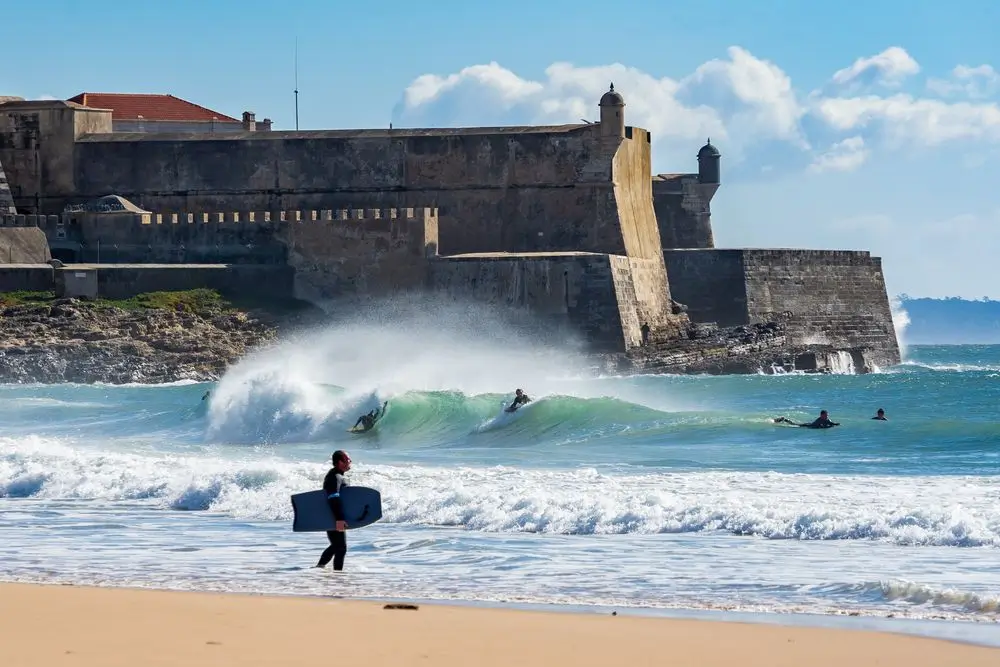
At Carcavelos, you surf an urban beach with several peaks, about 25 minutes by train from Lisbon: it is one of the spots closest to the capital. Further west, past Cascais, Guincho beach is powerful and windy, in the Sintra-Cascais natural park: go in the morning, before the nortada. All the spots are in our guide to surfing in Lisbon.
Ericeira: the World Surfing Reserve
Ericeira is a World Surfing Reserve. About 3 km north of the centre, the Ribeira d’Ilhas right peels for a long way: it is for intermediate and advanced surfers. To learn, head south instead, to the Foz do Lizandro beach break. Just north of the centre, Praia da Empa is a bay of reefs, for intermediate and advanced surfers. North of Ericeira, Coxos and Pedra Branca are for advanced surfers only. The details are in our guide to the surf spots in Ericeira.


Peniche and Baleal: Supertubos and the surf school beaches
In Peniche, the Supertubos wave is a beach break known for its barrels, which hosts a stop on the WSL pro tour. On the other side of the peninsula, Baleal Norte, the beginners’ beach in Peniche, is sheltered from big west swells by the island: that is where the schools go. All the spots are in our guide to surfing in Peniche.
Nazaré: the giant waves
In Nazaré, the giant waves of Praia do Norte are watched from the lighthouse. The underwater canyon off the beach makes the swell grow. In October 2020, Sebastian Steudtner surfed a 26.21-metre wave there, the world record certified by Guinness. The big swell season runs from October to March.

The north: Porto and Matosinhos
The north of Portugal is less crowded. At Matosinhos, Porto’s beach, many schools give lessons. In winter the water is cold there: a 4/3 is a minimum.
Surfing in Portugal - Practical info
Surf
- Level: All levels
- Wave types: Beach breaks, reef breaks, point breaks
- Bottom: Sand, reef
- When to go: All year round
- Best time:
- September to November: the best time, with consistent swells and still-mild water
- December to February: more powerful swells (intermediate to expert)
- March to August: gentler conditions (for beginners)
- Average water temperature: 14 to 20 °C depending on the season and region
- Average air temperature: 8 to 29 °C depending on the season and region
- Surf schools: Lots of them (Ericeira, Peniche, Algarve)
- Gear: Easy to rent, a 3/2 in summer and a 4/3 in winter
- Wind: Frequent, often offshore in the morning (nortada common in summer)
Before you go
- Time zone: UTC+0 (UTC+1 in summer), same as London
- Flight time:
- London → Lisbon: ~2h40
- London → Faro: ~2h45
- Main airports: Lisbon (LIS), Porto (OPO), Faro (FAO)
- Documents: Valid ID card or passport (EU); check entry rules for your nationality
- Required vaccines: None
- Recommended vaccines: Routine vaccinations up to date
- Travel insurance: Recommended
- Surf luggage: Extra fee depending on the airline, check before booking: read our guide to travelling with your surfboard
On site
- Language: Portuguese (English widely spoken, especially in surf and tourist areas)
- Currency: Euro (€)
- Safety: Safe destination, low crime
- Getting around: Car hire strongly recommended (spots are often spread out), trains and buses between the main cities
- Accommodation: Surf houses, hostels, Airbnb, hotels
- Internet: Very good (4G/5G, reliable wifi)
- Health: Modern facilities, European Health Insurance Card (EHIC) valid for EU travellers
- Food: Fresh fish, seafood, local dishes (bacalhau), plenty of vegetarian/vegan options
- Nightlife: Lively in Lisbon, Porto and Ericeira; quieter in the Algarve out of season
Surfing in Portugal for beginners
Learning to surf in Portugal
You will find schools on almost every well-known beach, and lots of sandy beach breaks. In the Algarve, Praia do Amado is the surf school beach, with several peaks. In Peniche, Baleal Norte is sheltered from big west swells by the island. Near Lisbon, Carcavelos is a train ride from the centre, but it is crowded.
In summer, the waves are small: it is the easiest season to learn. Surf in the morning, before the nortada picks up. In spring, the waves stay small and consistent.
Surfing solo in Portugal as a woman
Going on a solo surf trip to Portugal is easy: there are lots of schools, surf houses and travellers, and you quickly meet people.
Ericeira, Peniche and the Algarve have spots for every level. On your own, you choose your sessions and your pace.
“I travelled solo for 2 weeks in the Algarve. I loved it! I rented a car at Faro airport and drove to my surf camp in Sagres. Everything is easy there and you meet lovely people.”
Plan your surf trip to Portugal: tips and safety
A few tips before you go.
Safety in the water
Rip currents are the main hazard. In Peniche and Ericeira, it is crowded: respect the locals and priority.
- Check the swell, the wind and the tide before you paddle out.
- Respect priority.
- Learn to spot currents, and if you are a beginner, stay away from them.
- Do not surf alone if you lack experience.
- Pick a spot that matches your level.
Crowds
Lisbon, Ericeira and Peniche are very busy in summer. Surf early in the morning.
Vans and camping
Sleeping in a van is regulated: banned in protected areas and outside authorised areas. Use campsites and motorhome areas.
Getting around
A car is still the easiest way to switch spots depending on the swell. You can rent one in Lisbon, Porto or Faro. Trains and buses link the main cities.
SURFERS’ REVIEWS of Portugal
Have you surfed in Portugal? Share your experience.
Your feedback will help surfers of your level plan their trip.
Marion – beginner surfer
I went surfing in Portugal 3 times (Lisbon, Peniche and Sagres). I loved all 3 destinations but the vibe in Sagres was very pleasant. Not many people in the water, a women-only surf camp and really nice waves. And we saw dolphins 🙂
- September 2023
- Portugal
What to do in Portugal besides surfing?
On flat days, here are a few ideas, from south to north.
The Costa Vicentina and the Algarve
The Trilho dos Pescadores, the Fishermen’s Trail of the Rota Vicentina, runs along the cliffs of the west coast. You can walk a stage between two sessions. In the Algarve, you can kayak along the caves, from Lagos or Benagil.
Lisbon and Sintra
In Lisbon, walk the lanes of Alfama and go to Belém to see the Jerónimos Monastery and Belém Tower, UNESCO World Heritage Sites since 1983. About 40 minutes away by train, Sintra and its palaces in the forest form a cultural landscape listed by UNESCO since 1995.
Peniche and the Berlengas islands
From Peniche harbour, a boat goes to the Berlengas archipelago, a UNESCO biosphere reserve since 2011. The crossing season runs mainly from May to September. On Berlenga Grande, the 17th-century São João Baptista fort is linked to the island by stone bridges.
Nazaré
In winter, climb up to the lighthouse of São Miguel Arcanjo fort to watch the giant waves of Praia do Norte.
Porto
In Porto, the historic centre and the Ribeira quays have been a UNESCO World Heritage Site since 1996. And everywhere, eat grilled fish and pastéis de nata.
All the guided activities in Portugal
FAQ – Surfing in Portugal
Where to surf in Portugal?
There are spots for every level, from the Algarve to the north. To learn, go to Praia do Amado, Baleal or Foz do Lizandro. In Ericeira, Coxos and Cave are for advanced surfers. In Nazaré, the giant waves are watched from the lighthouse.
Where are the biggest waves in Portugal?
In Nazaré, at Praia do Norte, thanks to the underwater canyon off the beach. Sebastian Steudtner surfed a 26.21-metre wave there in October 2020, the world record certified by Guinness. The big swell season runs from October to March. For powerful but surfable waves, go to Supertubos (Peniche) or Coxos (Ericeira), for advanced surfers.
What is the surf capital of Portugal?
The names that come up most are Ericeira and Peniche. Ericeira has been a World Surfing Reserve since 2011, the first in Europe. Peniche hosts a stop on the WSL pro tour at Supertubos.
When to surf in Portugal?
Autumn (September to November) is the best season: consistent swells, still-mild water, wind often offshore in the morning. Winter is for advanced surfers. In summer, the waves are small, good for beginners, but the nortada picks up in the afternoon. Bring a 3/2 in summer and a 4/3 in winter.
Information may change. This guide is for general guidance only: surf conditions, temperatures, access, opening hours and prices can change. Before your trip and every session, check the forecast, local conditions and information from local providers. A spot description and its suggested level are no guarantee of safety: always match your session to your level and the conditions on the day. Learn more
Updated November 2026
Sources: Ericeira Mag, Guinness World Records, Visit Portugal, IPMA, Seatemperature.info, UNESCO, Routard, Rota Vicentina, The Surf Atlas, Mondo Surf.