Accueil » Destinations » Canary Islands
Surfing the Canaries: the ultimate guide to an unforgettable surf trip
It’s hard to find a closer approximation to surfing paradise. The Canaries offer waves almost every day of the year, a climate that makes you forget winter, and a unique atmosphere of Spanish villages and volcanic landscapes. To compare with Morocco, Senegal or Cape Verde, read our winter surf guide for beginners.
Only a few hours by plane from Europe, the archipelago attracts beginners and experienced surfers alike. You’ll come for the ocean, but leave marked by everything else.
At a glance: where to surf in the Canary Islands
| Level | All levels depending on the island: sandy beaches to learn (Famara, El Médano, El Cotillo), powerful reefs for experienced surfers (El Quemao, Lobos, El Confital) |
| Best season | October to March for north and northwest swells. From May to September, smaller waves, good for beginners |
| Water temperature | Around 19 °C from February to April, 23 to 24 °C from August to October (Tenerife data) |
| Wetsuit | 3/2 mm in winter, shorty or rash vest in summer |
| Islands for surfing | Tenerife, Lanzarote, Fuerteventura and Gran Canaria |
| Getting there | Direct flights from France to the four main islands in about 4 h to 4 h 30, then ferries or Binter flights between the islands |
Why do surfers dream of the Canaries?
They’re sometimes called the “Hawaii of the Atlantic”. It’s true that everything here seems to come together: regular swells, mild temperatures and a wide variety of spots. The waves are there, constant and often powerful.
But beyond the surf, it’s a special atmosphere. You go from a black, tube-spitting reef to a terrace where you can enjoy grilled fish with a glass of volcanic wine. The contrast is stark, and that’s what makes the Canaries so special. To learn how to surf or improve more quickly, you can also check out the surf camps in Tenerife, which combine accommodation and lessons with instructors.
“I am gone surfing for 3 months in Lanzarote and 1 month in Tenerife and I loved both destinations. They are completely different but the a15> both are pleasant to live in for a surfing trip.”
Surf camp in the Canary Islands
A surf camp bundles accommodation, lessons, gear and often the airport transfer. It is the easiest option for a first surf trip to the Canary Islands, especially in Tenerife and Lanzarote. To compare places, read our comparisons of surf camps in Tenerife and surf camps in Lanzarote.
Do you run a surf camp in the Canary Islands?
Present your camp to readers planning their surf trip to the Canary Islands.
List my surf campWhen should you go surfing in the Canaries?
The correct answer is: all the time. But not for the same reasons.
- October to March: the archipelago takes on a whole new dimension. Winter swells awaken the reefs. El Quemao on Lanzarote or El Confital on Gran Canaria become real challenges. Experienced surfers are in for a treat. If you are going over the festive season, our guide to surfing in December compares the islands with Morocco, Senegal and the West Indies. For a trip after the holidays, see our guide to surfing in January. In February, Tenerife remains a safe bet for surfing in the sun: find it in our guide to surfing in the Canary Islands in February.
- May to September: the atmosphere changes. The waves are smaller, perfect for learning or improving without stress. The sandy beaches fill up with surf schools, and the ocean remains welcoming. Where to surf in May to improve your surfing skills.
Water temperature fluctuates between 18 and 23°C. A 3/2 mm is more than sufficient in winter. In summer, many surfers wear shorts, and some even leave their wetsuits in the closet.
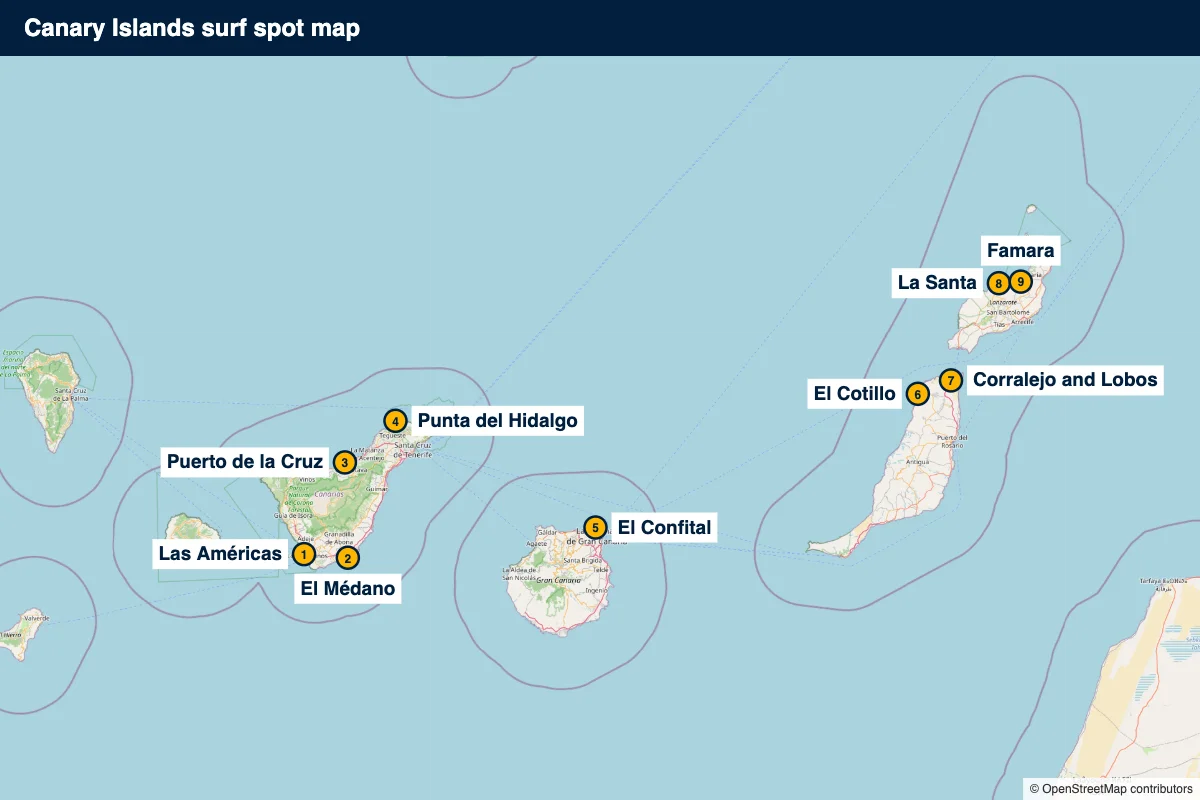
Where to surf in the Canary Islands by level? The best spots
The surf spots of the Canary Islands are spread over four islands: Tenerife, Lanzarote, Fuerteventura and Gran Canaria. The north and west coasts get the winter swells, the south and east coasts are more sheltered. Here are the spots sorted by level. Those with a link have their own detailed guide.
Surf spots in the Canary Islands for beginners
| Spot | Where | The wave |
|---|---|---|
| Famara | Lanzarote, north-west coast | Long sandy beach with several peaks and surf schools, gentler at low tide |
| El Médano | Tenerife, south-east | Sand and pebble beach break, gentle waves on small swells |
| El Conquistador | Tenerife, Las Américas | Reef covered with sand and pebbles, the school wave |
| Playa Jardín | Tenerife, Puerto de la Cruz | Black sand beach, left and right peak, area open to surfing |
| Playa Martiánez | Tenerife, Puerto de la Cruz | Black sand beach with surf schools |
| El Cotillo | Fuerteventura, north-west | Sandy beach break, less consistent conditions |
| Flag Beach | Fuerteventura, Corralejo | Sand and rock beach break, surf schools on site |
Surf spots in the Canary Islands for intermediates
| Spot | Where | The wave |
|---|---|---|
| La Izquierda | Tenerife, Las Américas | Left over reef, often crowded |
| Punta del Hidalgo | Tenerife, north-east | A-frame reef, long rights and shorter lefts |
| El Socorro | Tenerife, Los Realejos | Sand and pebble beach break, lefts and rights |
| San Juan | Lanzarote, Caleta de Famara | Reef, fast left that can barrel and a softer right |
Surf spots in the Canary Islands for experienced surfers
| Spot | Where | The wave |
|---|---|---|
| El Quemao | Lanzarote, La Santa | Powerful hollow reef, barrels up to 5 m, mostly at high tide |
| Lobos | Fuerteventura, Lobos island off Corralejo | Long right that can run up to 500 m, powerful |
| El Confital | Gran Canaria, Las Palmas | Fast hollow right over a volcanic ledge, at high tide |
| La Derecha del Cartel | Tenerife, Las Américas | Long right over rock, from 1.5 m of swell |
| La Isleta | Lanzarote, La Santa | Several shallow reefs, hollow rights, holds big swell |
Surf spot guides in the Canary Islands
Surf spots in the Canary Islands: the best islands
Nestled in the Atlantic Ocean some 100 km off the coast of Africa, the Canary Islands form a volcanic archipelago of Spanish islands that captivate visitors with their diversity of landscapes and privileged climate.
Comprising seven main islands, Tenerife, Gran Canaria, Lanzarote, Fuerteventura, La Palma, La Gomera and El Hierro, this archipelago is a popular destination for learning to surf in ideal conditions.
Tenerife
Tenerife is the epitome of everything the Canaries have to offer. The largest island, the most populated too, and without doubt the one that best combines classic tourism and surf culture. In the south, Las Américas lines up several reefs, including La Izquierda, a left that is very popular with locals and travellers alike.
A few kilometers further on, El Médano offers a more family-friendly atmosphere, ideal for learning, with accessible waves and a constant wind that also attracts kite and windsurfers. The wilder north of the island hides Igueste, a powerful left in the middle of green mountains.
Tenerife also boasts a lively nightlife, charming villages and the Teide mountain that dominates the horizon, reminding us that here, nature is always present.
Read our complete guide to surfing in Tenerife.
Lanzarote
Lanzarote is striking at first sight. Dark volcanoes, frozen lava fields, and in the middle, beaches swept by the Atlantic. The island is a land of contrasts: on one side, El Quemao, a brutal, tubular left that’s one of Europe’s most respected waves. On the other, Famara, an immense bay of blond sand surrounded by cliffs, where surf schools set up every day to initiate beginners.
There are also intermediate reefs like San Juan, perfect for progressing. But Lanzarote is more than just waves: it’s a rootsy atmosphere, white villages lost in volcanic rock and a tight-knit surf scene.
Discover our complete article on surfing in Lanzarote.
Fuerteventura
Probably the most surf trip island in the Canaries. Here, everything exudes surf travel: roads running along deserted beaches, immense dunes, and above all a northern coastline, the famous North Shore, that rolls out spot after spot, almost without interruption. It’s an endless playground for experienced surfers.
But Fuerteventura also knows how to be gentle: Morro Jable, to the south, welcomes beginners in calmer conditions. To the north, Corralejo lives to the rhythm of surfing. Here you’ll find surf camps, bars, backpackers and an international atmosphere where evenings often stretch late into the night. In short: a complete, accessible island with a change of scenery, seduced as much by its waves as by its adventure.
See our dedicated guide: surfing in Fuerteventura.
Gran Canaria
Often overlooked, Gran Canaria deserves attention. The island boasts powerful, sometimes even violent waves, as well as accessible urban spots. In Las Palmas, the beach at Las Canteras allows you to surf at sunrise, then head into town for a coffee a few minutes later. A few steps away, El Confital unleashes passions: a world-class, hollow and fast right, reserved for confirmed surfers.
The atmosphere is more local, and more intense too. Gran Canaria surprises with its mix of wild nature in the center of the island and urban life on the coasts.
Little sisters: La Gomera, El Hierro, La Palma
These islands don’t always appear in surf guides, and that’s what makes them so charming. There are no crowds here, no surf camps around every corner. The waves are less regular, sometimes fickle, but the experience is unique.
Surfing in La Gomera means being almost alone in the water, surrounded by lush nature.
El Hierro, known for its exceptional seabed, also offers some quality sessions when the conditions are right.
As for La Palma, the “green island”, it appeals to travellers looking for authenticity above all else. These destinations are for those who want to get off the beaten track and experience surfing differently, in direct contact with nature.
Surfing in the Canary Islands: practical information
Surfing
- Level: Perfect for beginners and intermediates
- Wave type: Gentle beach breaks, slow and steady waves
- Type of bottom: Mainly sandy on beginner spots
- When to go: All year round
- Best period: April to October for milder conditions
- Average water temperature: 19-23°C
- Average ground temperature: 18-25°C
- Recommended wetsuit: 3/2 mm in winter, shorty or lycra in summer.
Before you leave
- Time difference: -1h to France
- Flight time (from Paris): 4h to 4h30
- Main airports: Lanzarote (ACE), Fuerteventura (FUE), Tenerife North (TFN) and South (TFS), Gran Canaria (LPA)
- Travel time to site: 30min to 1h from airports
- Documents required: Identity card or passport for European nationals
- Vaccines required: None
- Recommended vaccines: Standard vaccine updates
- Insurance: Recommended, as some spots are technical. Check that your policy covers surfing.
On site
- Spoken language: Spanish (English current in surf schools)
- Currency: Euro
- Cost of living: Moderate (€30-40/day for surf lessons)
- Safety: Very good
- Getting around: Surf school shuttles, car rental recommended for greater flexibility
- Inter-island transport: Ferries (Fred Olsen, Naviera Armas) and Binter Canarias flights
- Internet connection: Good 4G/5G coverage, wifi available in most accommodations
- Surf camp price: 250-400€/week including accommodation
Surfing in the Canary Islands for beginners
For your first waves, the islands have plenty of sandy beaches. In Lanzarote, Famara is the classic for surf schools: aim for low tide, when the waves are gentler. In Tenerife, El Médano in the south and the beaches of Puerto de la Cruz in the north welcome beginners on small swells. In Fuerteventura, El Cotillo works too, although conditions there are less consistent.
Take lessons for the first few days: instructors know the sandbanks and the right tide times. And leave the reefs like El Quemao, Lobos or El Confital to experienced surfers.
Budget for a surf trip to the Canary Islands (excluding flights)
A surf trip to the Canaries is still very affordable compared to other destinations.
- Flights: €80 to €200 return depending on season.
- Accommodation: surf camp €250-400/week, hostels from €25/night, apartments €50-80/night.
- Surf: group lessons €35-50/day, surfboard rental €15-20/day.
- Transport: car rental €20-30/day, petrol cheaper than in Europe.
- Food: local meal €10-15, tourist restaurant €20-30.
Expect to pay an average of €600-800 for an all-inclusive week (excluding flights). In backpacker mode, possible around €400-500, and in comfort mode around €900-1000.
Practical tips for surfing in the Canaries
The Canaries are easy to get to. Low-cost flights leave from all major European cities. Outside school vacations, you can easily find a return ticket for less than €100.
On site, it’s best to rent a car. The spots are scattered, and buses are not made for surfers loaded down with boards. There’s a choice of surf houses, hostels, apartments and hotels.
Bring your board? Not essential. Surf shops are well equipped. If you insist on surfing with your board, protect it well: airlines are not always careful.
A useful reminder: many waves break on reef. The ocean is powerful. Find out what’s going on before you get in the water, and respect the locals.
Getting around between the Canary Islands
To surf several islands, you can choose between the ferry and the plane. Fred Olsen and Naviera Armas ferries link the main islands, and Binter Canarias flights are faster. Short crossings, such as between Lanzarote and Fuerteventura, cost around €20.
Timetables, durations, prices and tips for your board: read our guide to organising your transport between the Canary Islands.
SURFER REVIEWS of the Canary Islands
Have you surfed in the Canary Islands? Share your experience.
Fanny – intermediate level
I went surfing in Lanzarote for a week in March. The conditions were ideal for improving, with consistent waves and few people during the week. I particularly enjoyed the variety of spots, which makes it easy to adapt to your level and the weather. The water was cool but bearable in a 3/2 wetsuit, and the atmosphere on the island is very relaxed. I would recommend Lanzarote to intermediate surfers looking to gain confidence while discovering a unique volcanic setting.
- Trip in March
- Lanzarote
Aurelie – intermediate level
Great rights in Famara 🤙 Perfect water temperature in the middle of winter.
- February 2023
- Famara, Lanzarote
Dimitri – beginner level
I loved my surf trip to Lanzarote: between the beauty of the lunar landscape, the vibe at the spot and the slow life in Famara, it is clearly a place I would like to come back to.
- May 2025
- Lanzarote
What else is there to do in the Canaries apart from surfing?
Surfing is a big part of the trip, but it would be a shame to stop there.
Walking on volcanoes
In Lanzarote, Timanfaya Park is impressive. Lava fields, red and black colors, a setting that seems to come from another planet. In Tenerife, Mount Teide dominates the island. Climbing up there at sunrise is an unforgettable experience.
Exploring the seabed
The Canaries are also a diving paradise. El Hierro is renowned for its crystal-clear waters and biodiversity. Even when snorkeling, you’ll come across colorful fish, rays and sometimes turtles.
Discover the local culture
Markets are everywhere. You can taste goat’s cheese, mojo picon and tropical fruit. In the villages, the atmosphere is Spanish and relaxed. In La Gomera, traditions such as silbo (whistling) still survive.
Enjoy the beaches
Every island has its pearls. On Fuerteventura, Cofete stretches for miles with hardly anyone around. Lanzarote seduces with Papagayo and its turquoise waters. Tenerife mixes black volcanic beaches with artificial sandy beaches.
Going out in the evening
Corralejo is as alive at night as it is during the day. Bars, concerts and a relaxed atmosphere. In Tenerife, Playa de las Américas attracts those who like their evenings livelier, sometimes well into the night.
All guided activities in the Canaries
FAQ: everything you need to know about surfing in the Canary Islands
What are the best surf spots in the Canaries?
The beaches of Famara on Lanzarote, El Cotillo and Flag Beach on Fuerteventura, and Las Canteras on Gran Canaria are ideal for beginners, with their gentle waves and sandy bottoms.
Which Canary Island should you choose to learn to surf?
Fuerteventura and Lanzarote are the most recommended islands for beginners, offering many suitable surf spots and a high concentration of qualified surf schools.
Should I book surf lessons in advance?
It’s advisable to book in advance during the high season (July-August), but outside this period it’s usually possible to register on the spot.
How much does a beginner's surf lesson in the Canaries cost?
Expect to pay around €30-40 for a 2-hour group lesson, and between €150-200 for a pack of 5 lessons including equipment hire.
What wetsuit should you wear to learn to surf in the Canaries?
A shorty wetsuit (2mm) is sufficient in summer, while a light wetsuit (3/2mm) is recommended during the winter months for beginners who spend a lot of time in the water.
Can families learn to surf in the Canaries?
Updated October 2026
Sources: Hello Canary Islands, Manawa, Ferryhopper, Mondo Surf, Surf-Forecast, Weather2Travel