


Dying to see the legendary Nazaré waves in Portugal with your own eyes, but afraid you’ll book your trip at the wrong time? This guide finally cracks open the canyon’s mechanics and the ideal windows to lock in your front-row seat at this oversized water show. Get ready to learn the forecast secrets and the wild stories of the surfers who take on the Atlantic’s fury. For the intermediate option in Ericeira, see our full spot guide on Ribeira d’Ilhas. Over in Ericeira, the advanced/expert reef break is Coxos, a renowned hollow left. Heading further south to Peniche? More on local stays here: https://travel-surf.com/best-surf-camps-peniche/.
- Nazaré: the underwater secret behind the giant waves
- Monster season: when to see Nazaré waves?
- The gladiators of Nazaré: surfers who defy the impossible
- Surfing Nazaré: an elite-only game
- Nazaré: from fishing village to XXL surf capital
Nazaré: the underwater secret behind the giant waves
Ever wondered why it breaks so hard here? It’s not a weather fluke or a wind whim. The real culprit is hidden under the water, an invisible, massive geological secret that changes everything.
The Nazaré canyon, a monster under the ocean
Forget the beach for a second, because everything happens below. The famous Nazaré Canyon is the real conductor here. This hidden relief is what changes the game for surfers.
Hold on: this trench is 230 kilometers long and plunges to 5,000 meters deep. That’s much deeper than the famous Grand Canyon in the USA. We’re dealing with a true underwater fault.
This huge void, invisible from the surface, explains why this spot is unique. Without it, Nazaré would just be an ordinary beach with no interest for big-wave surf.
How the swell turns into a mountain of water
The mechanism is simple to grasp. The Atlantic swell rolls in from offshore and splits cleanly in two when it meets the head of the canyon.
The part on the continental shelf slows down because the bottom rises fast. The part traveling through the deep canyon, on the other hand, keeps all its initial speed. This timing gap is fundamental.
The grand finale plays out at the reunion in front of Praia do Norte. The two swells stack up brutally and their combined energy creates a liquid pyramid mountain that seems to rise from nowhere.

Praia do Norte: the arena of titans
This is where it hits hardest. Praia do Norte is the precise impact point where the Nazaré waves reach their max size. The show is terrifying and grand.
Right next door, Praia da Nazaré stays calm, sheltered by the rocky headland. This contrast makes the chaos triggered by a giant underwater fault even wilder. It’s a one-of-a-kind show.
No surprise the spot is nicknamed the Mecca of big-wave surfers. It’s the ultimate pilgrimage for the elite.
Monster season: when to see Nazaré waves?
Big swell calendar
Want to catch the show? Block your calendar for the big-wave season, running October through March. That’s exactly when winter throws its most violent storms across the Atlantic.
To max your chances, aim for the heart of the action between November and February. That’s when the canyon really fires up. Your best window to see walls of water over 20 meters.
The rest of the year? Forget it. Nazaré tucks its fangs away and becomes a quiet beach town again, perfect for sunbathing but not for adrenaline.
Decoding the forecast: small, big or giant?
Showing up randomly is the classic mistake 90% of disappointed tourists make. You have to watch the weather charts like a hawk. Sign up for email alerts and check specialized sites before booking your flight.
Watch the local vocabulary. Here, “big” doesn’t mean what it does in Biarritz. People talk about giant waves starting at 12-15 meters. Anything below is just a warm-up for the pros.
| Category | Height in meters | Description for newcomers |
|---|---|---|
| Small | < 3m | Surfable for everyone |
| Medium | +3m | For experienced surfers |
| Big | +7m | Show guaranteed |
| Giant | +15m | Potential record day! |
If you want to avoid traveling for nothing, take a look at the Nazaré forecast. It’s the basics to not miss the moment.
“Big days”: out-of-this-world sessions
The vibe of a “big day” is unreal. The cliff vibrates under your feet, the noise is deafening, like a plane taking off. You can feel the tension rise among the crowd and the safety crews.
Look at the 2025/2026 season: monsters over 20 meters rolled in early December 2025. Late January 2025, same deal. These specific windows are the ones that write surf history.
These days are rare, which is what makes them precious. Watching this Nazaré wave fury is a real pilgrimage. An experience that marks you for life.
The gladiators of Nazaré: surfers who defy the impossible
But who are these madmen who dare to throw themselves into these mountains of water? They are not ordinary surfers, believe me.
The pioneers and record holders
It all started with Garrett McNamara’s vision. This American pioneer literally put Nazaré on the world surf map in 2011 with his record wave at the time.
A real record race kicked off at the spot. Brazilian Rodrigo Koxa stunned the world in 2017, followed by German Sebastian Steudtner, the current world record holder.
Steudtner tamed a monstrous 26.21-meter wave on October 29, 2020. That’s the Guinness-certified record.
The French connection at the top
On the French side, no one’s just along for the ride. Justine Dupont stands out as one of the world’s best big-wave surfers, a key figure at Nazaré.
You’ll also see other notable French names like Clément Roseyro in the water. Their presence is constant on the biggest swells, marking the recognition of French expertise in this field.
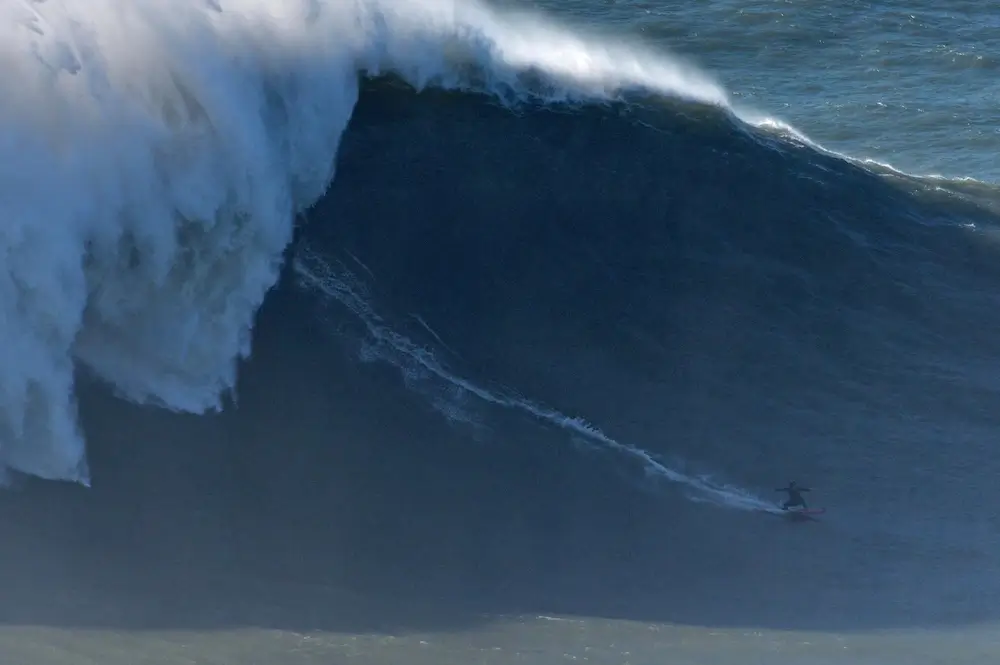
Here are the legends you’ll hear about all over the cliff:
- Garrett McNamara (USA): The pioneer.
- Sebastian Steudtner (GER): Current record holder (26.21m).
- Justine Dupont (FRA): The queen of Nazaré.
- Lucas “Chumbo” Chianca (BRA): The acrobat of the giants.
Competitions: the ultimate challenge
Competitions here are rare but wildly intense. The Tudor Nazaré Big Wave Challenge is the flagship event to take on Nazaré waves.
Heads up, these competitions never run on a fixed calendar. They are called at the last minute when a big enough swell is confirmed, adding to the suspense.
Look at a recent winner, like Lucas Chianca for the 2025/26 edition, to grasp the level of commitment required.
Surfing Nazaré: an elite-only game
Tow-in: the key to dancing with the giants
You think you can paddle into Nazaré waves with arm power alone? Forget it, it’s a lost cause. The travel speed of these water monsters is far too high for a classic human take-off.
That’s where tow-in changes the game and makes the impossible accessible. The principle is simple but radical: a jet-ski tows you at full power and drops you precisely at the critical moment on the wave’s crest.
This technique was a turning point in surf history. It let chargers tame water walls once thought unsurfable, pushing the limits of the sport.
More than a sport, a team effort
Taking on this iconic spot isn’t a solo feat, it’s a real survival pact. The jet-ski driver is just as crucial as the rider; they form a tight duo, a fused team against the elements.
The driver’s job doesn’t stop at the launch. They are your life insurance, ready to read the ocean to pick you up urgently after a wave or, above all, to save you after a violent fall.
A spot to respect: the danger is real
Make no mistake: here, mistakes cost you and risk is everywhere. The phenomenal impact, the tricky currents and the breaking zone make Nazaré an extremely dangerous arena where death lurks.
Even legends aren’t safe, as Carlos Burle’s scare in December 2025 showed. Swallowed by the swell, it took a heroic rescue to avoid tragedy, a reminder that no one is untouchable.
Let’s be clear: this is absolutely not a spot for beginner surf, nor for intermediates. If you want to learn to tame powerful waves, train somewhere else; here, it’s the exclusive turf of world experts. To level up further south, see our comparison of surf camps in Ericeira.
Nazaré: from fishing village to XXL surf capital
The McNamara revolution
Before 2011, Nazaré was just a quiet fishing village. People came for the calm, the fresh fish and the women in their seven petticoats. It was pure authenticity.
Garrett McNamara’s arrival and his world record swept it all away. By taming a mountain of water, he pushed the town from anonymity to headlines worldwide. The shock was immediate.
That was the start of a new era for Nazaré, a real metamorphosis. Nothing would ever be the same.
Source: https://www.redbull.com/fr-fr/nazare-histoire-surf-gros
A new economic ecosystem
Winter, once a dead season, became the busiest period. Hotels, restaurants and surf shops popped up to build a whole economy around the waves. The town now lives on the rhythm of the swell.
Thousands of tourists and viewers flock from all over the world to see the show from the lighthouse. Everyone wants to feel the ocean’s breath.
With these terrifying water walls, Nazaré has climbed to the top of the world’s giant-wave rankings. It’s become the ultimate playground for the surf elite.
Keeping Nazaré’s soul
But a major challenge remains: how to handle this global success without losing local identity?
You’ll see two distinct faces in the streets:
- Traditional Nazaré: colorful fishing boats, fish drying on the beach and folkloric costumes.
- Modern Nazaré: pickup trucks loaded with jet-skis, surf shops and the international vibe of “big days.”
This mix is now part of the unique charm of the town facing the giant waves of Nazaré.
Nazaré is much more than a surf spot, it’s the stage for a unique showdown between man and nature. Whether you come for the thrill of the giant waves or the authenticity of the village, this experience will stay with you forever. So watch the forecasts and get ready: the monster is waiting for you this winter
FAQ
Insurance for your surf trip
Before you go, think about your surf travel insurance. Chapka covers broken gear, in-water injury, cancellation and repatriation for around €19/week — far better than what your credit card offers, with real coverage for surf sports. Free quote in 2 minutes.
The giant season runs mainly from October to March. It’s during winter that the North Atlantic lows send the strongest swells toward Portugal. To max your chances of seeing the show, aim for the November to February window, that’s often when the activity is at its peak.
It depends on the day and the weather. In classic winter sessions, waves often run 10 to 15 meters. But on the famous “big days”, when the canyon does its thing, we’re talking water walls over 20 meters! For exact height today, check the forecast sites and live webcams.
Right now, German Sebastian Steudtner holds the official world record. On October 29, 2020, he rode a monstrous wave measured at 26.21 meters. He beat the previous record by Brazilian Rodrigo Koxa (24.38 m). It shows just how far this spot pushes human limits.
The danger is everywhere and real. Pro surfer deaths stay rare thanks to highly prepared jet-ski safety crews, but serious accidents are frequent. Surfers like Alex Botelho or more recently Lucas Chumbo suffered serious injuries. It’s a hostile environment where the smallest mistake costs you.
For 2026, focus on the start of the year, especially January and February. The season usually wraps up at the end of March. Watch the long-term forecasts, since conditions can change fast. It’s often early in the year that the historic swells hit the coast.
Don’t show up blind! Watch the weather forecasts on specialized sites like Nazare Waves or Windguru. You can also subscribe to email alert systems that warn you when a big swell is coming. It’s the best way to not miss a “big day”.
The biggest wave ever surfed and certified by Guinness World Records is the one at Nazaré. At 26.21 meters, Sebastian Steudtner’s wave is the absolute reference. Nazaré is the arena where these records fall, confirming its status as world capital of big-wave surf.
At Praia do Norte, where the giant waves are, swimming is extremely dangerous and often forbidden because of the violent currents and the powerful shorebreak, even when waves look smaller. For swimming, prefer the village’s main beach in summer, which is a bit more sheltered, but stay very careful.
