Accueil » Destinations » Costa Rica » Tamarindo
Surfing in Tamarindo, Costa Rica: complete guide to spots and tips
Tamarindo, in Guanacaste, is the best-known surf village in Costa Rica. Playa Tamarindo, its long sandy beach, has gentle waves and surf schools all along it: one of the easiest places in Central America to learn. As you progress, Playa Grande, Playa Langosta, Avellanas and Playa Negra are a few minutes away, and boats to Witch’s Rock and Ollie’s Point leave from the nearby coast.
In short: surfing in Tamarindo
| Level | All levels: Playa Tamarindo for beginners, Pico Pequeño, Playa Grande, Langosta and Avellanas to progress, the estuary, Pico Grande and Playa Negra for experienced surfers |
| Best season | All year. December to April for beginners, May to October for the biggest south swells |
| Water temperature | 27 to 29 °C on average, sometimes cooler from December to April |
| Wetsuit | A rash vest is enough. A neoprene top can help on some dry-season mornings |
| Bottom | Sand, with rock and reef slabs on some peaks |
| Access | About 1 hour by road from Liberia airport, 4 h 30 from San José. Domestic flights to the small Tamarindo airport |
Why go surfing in Tamarindo?
Tamarindo has everything for a first surf trip: a sandy bay where waves often stay small, lots of schools, surf shops, and a village where you can walk everywhere. The water is warm all year. And as you progress, you have about ten spots within 30 minutes.
It is also the most touristy surf village in the country: the line-up gets crowded, prices are higher than elsewhere and the nightlife is lively. If you want something quieter, have a look at our Santa Teresa surf guide, and for the whole country, our guide to surfing in Costa Rica.
Playa Tamarindo: the beach and the village
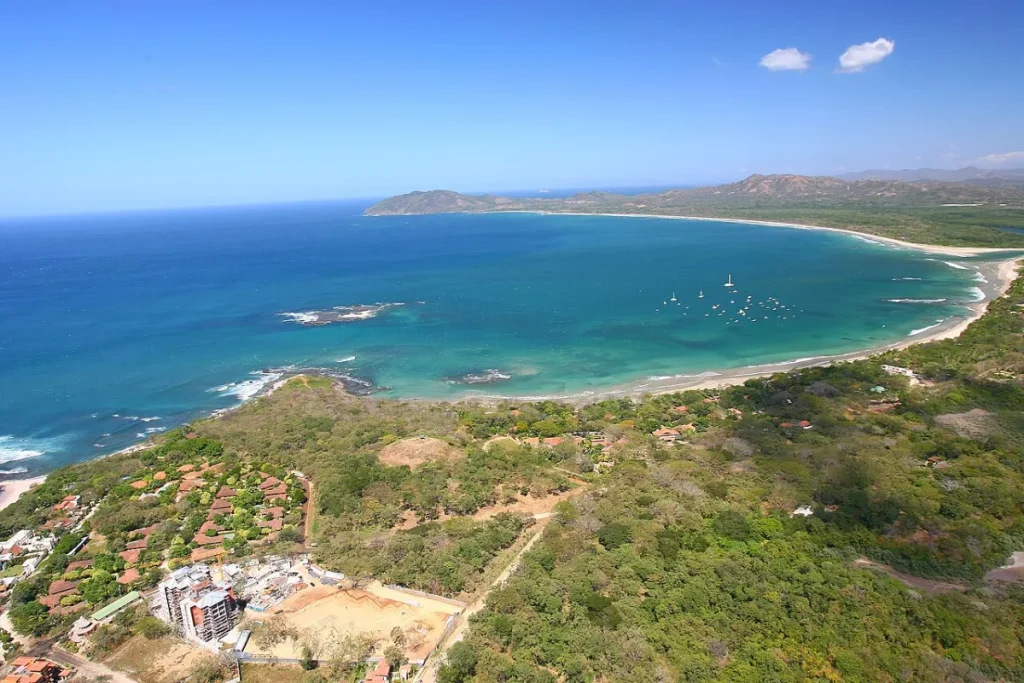
Playa Tamarindo is a long sandy beach of about 2.5 km in front of the village. To the north, the Tamarindo estuary separates it from Playa Grande. To the south, the beach runs to Playa Langosta, facing the small Capitán island. The estuary and Playa Langosta are part of Las Baulas Marine National Park, created in 1991 to protect leatherback turtles.
The village stretches along a main road with hotels, restaurants and surf shops. Tamarindo had about 8,000 inhabitants at the 2020 census. Crocodiles live in the estuary: never swim across it, take the small boat to Playa Grande. For swimming, the south end of the beach is more sheltered.
Surf camps and surf schools in Tamarindo
Tamarindo has all-inclusive surf camps, some of which also run boat trips to Witch’s Rock, and lots of surf schools right on the beach. Lessons usually last 1 h 30 to 2 hours, with board and rash vest.
Average price: about US$50 to 70 for a group lesson and US$80 to 100 for a private lesson.
Where to stay to surf in Tamarindo?
The centre: to do everything on foot, close to the schools and the main beach.
The south, towards Langosta: quieter, close to Pico Pequeño and Playa Langosta.
Playa Grande: mostly villas, more isolated, across the estuary.
Avellanas and Playa Negra: for surfers with a car who prefer peace and quiet.
Do you run a surf camp or surf school in Tamarindo?
Present your school to readers planning a surf trip to Tamarindo.
List my surf campWhen to go surfing in Tamarindo?
You can surf in Tamarindo all year. The bay mostly picks up northwest swells in the dry season and southwest swells in the green season.
December to April: the dry season
Blue skies, an often offshore morning wind and smaller waves: the best time for beginners. It is also high season, with more people and higher prices. Upwelling can cool the water on some days: a neoprene top can help.
May to November: the green season
South Pacific swells arrive, bigger and more consistent: the season for Playa Grande, the estuary and Pico Grande. Rain falls mostly in the afternoon. September and October are the wettest months, with over 350 mm of rain.
Water temperature and what to wear
On average, the water is 27 °C from January to April, 29 °C from May to August and 28 °C from September to December. A rash vest is enough most of the time.
Surfing in Tamarindo: practical information
Surfing
- Level: All levels
- Wave types: Beach breaks, river mouth and reef peaks
- Bottom: Sand, rock and reef
- When to go: All year
- Best time: December to April for beginners, May to October for big swells
- Water temperature: 27 to 29 °C on average
- Gear: Rash vest, water-resistant sunscreen, reef booties for the reef peaks
- Popular spots: Playa Tamarindo, Playa Grande, Playa Langosta, Avellanas, Playa Negra
Before you leave
- Time difference: UTC-6 all year, no daylight saving time
- Airports: Liberia (LIR), about 1 hour by road. San José (SJO), about 4 h 30 by road or about 50 minutes by domestic flight to Tamarindo (TNO)
- From Liberia: Shared shuttle from about US$30, private transfer around US$100, local bus for a few dollars
- Entry: Most European and North American visitors do not need a visa for a tourist stay. You need a passport valid at least until your departure date and a return ticket
- Safety: Thefts on the beach and from cars, currents, crocodiles in the estuary
On site
- Currency: Costa Rican colón, US dollars accepted almost everywhere
- Cost of living: Among the highest in the country
- Getting around: On foot in the village. Car or scooter for Avellanas and Playa Negra, on partly dirt roads
- Health: Bring mosquito repellent (dengue)
Tamarindo surf spots
The spots follow one another along about fifteen kilometres of coast: Playa Grande north of the estuary, Playa Tamarindo and its reef peaks in front of the village, Playa Langosta to the south, then Avellanas and Playa Negra 20 to 30 minutes away by road.
Learning to surf in Tamarindo
Playa Tamarindo is one of the best places in the country to learn: sandy bottom, often small waves in the bay and lifeguards on the beach. The downside: a crowded line-up.
Progressing in Tamarindo
Pico Pequeño at high tide, Playa Grande, Playa Langosta and Avellanas are more powerful. Check the conditions of the day before paddling out.
Surfing in Tamarindo as an experienced surfer
The estuary mouth, Pico Grande and Playa Negra need experience. For the legendary waves, Witch’s Rock and Ollie’s Point are day trips by boat.
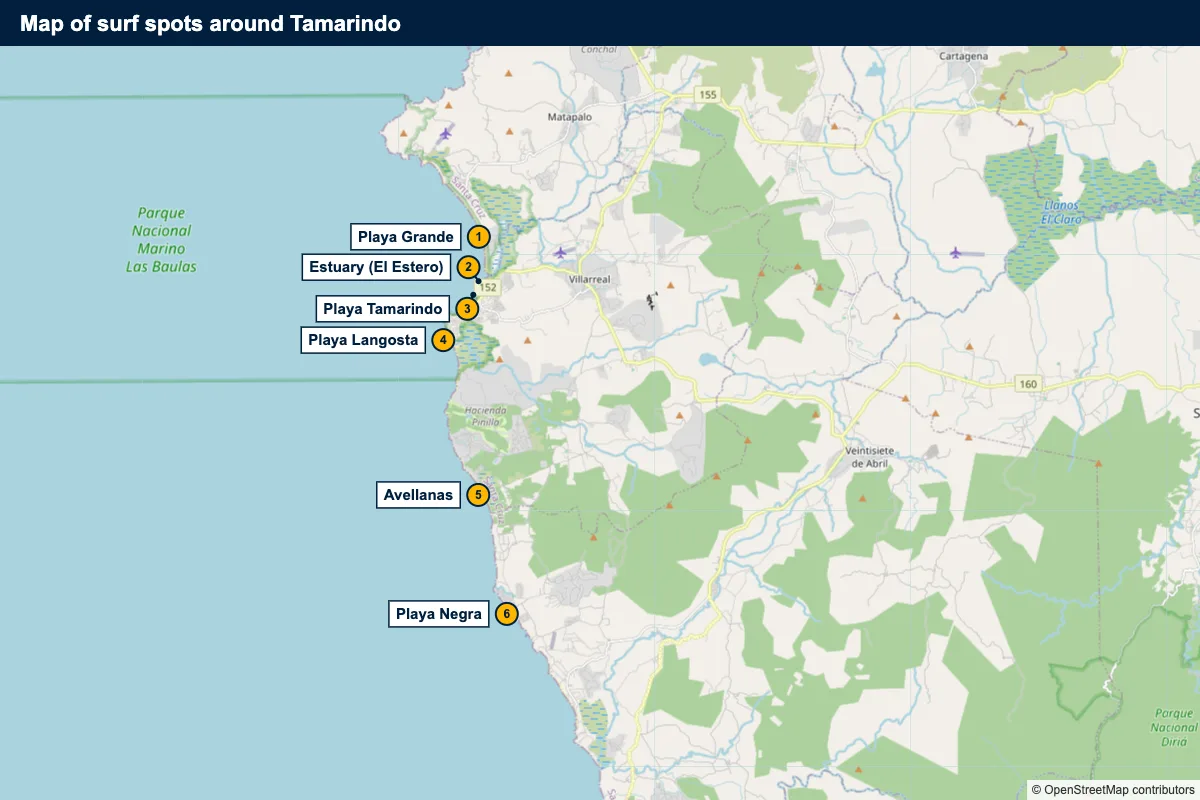
Surf spots in Tamarindo for beginners
| Spot | Where | The wave | Tide |
|---|---|---|---|
| Playa Tamarindo | In front of the village, in the middle of the bay | Sand beach break with a few rocks, gentle lefts and rights. Schools and lifeguards, crowded | Mid to high tide, on the rising tide. Faster with currents at low tide |
Surf spots in Tamarindo for intermediates
| Spot | Where | The wave | Tide |
|---|---|---|---|
| Pico Pequeño | South of the main beach, on the first lava outcrop | Peak that reforms over reef then sand, mostly lefts. Lots of young locals. Advanced beginner to advanced | High tide only |
| Playa Grande | North of the estuary, Las Baulas National Park | Sand beach break, more powerful than Tamarindo. Strong currents, no lifeguard | Mid to high tide |
| Playa Langosta | South of Tamarindo, Las Baulas National Park | Beach break over sand and uneven reef, lefts and rights. Rocks and a coral head near the river mouth, few people | Rising tide, low to mid tide |
| Avellanas | About 25 min south | Several peaks over sand and rock slabs, holds bigger swells than Tamarindo. Rocks | All tides |
Surf spots in Tamarindo for experienced surfers
| Spot | Where | The wave | Tide |
|---|---|---|---|
| The estuary (El Estero) | River mouth north of Playa Tamarindo | Mostly rights over shifting sandbars, steep take-offs. Crocodiles reported, currents | Mid to high tide |
| Pico Grande | Just outside Pico Pequeño | Short, hollow right over a lava slab, for experienced surfers only | Mid to high tide, ideally 2 hours before high tide |
| Playa Negra | About 30 min south | Hollow reef right with a channel. Urchins | Mid tide |
Witch’s Rock and Ollie’s Point, in Santa Rosa National Park, are surfed on day trips by boat. Boats leave from Playas del Coco, with a transfer from Tamarindo around 5 am and a return around 4 pm. Allow about 1 h 30 by boat, the park entrance fee (US$17 per person) and US$600 to 750 per boat before tax.
Tamarindo forecast
Wind, gusts and Windguru rating over 7 days in Tamarindo:
To follow the swell: Surf-Forecast (Tamarindo).
Surf spot guides in Costa Rica
SURFER REVIEWS in Tamarindo
Have you surfed in Tamarindo? Share your experience. Your feedback will help surfers of your level plan their trip.
Tamarindo, Nosara or Santa Teresa?
They are the three best-known surf villages on Costa Rica’s Pacific coast.
Tamarindo: the easiest
About 1 hour from Liberia airport, with a bay for beginners, lots of spots around and a real village life. The busiest and liveliest.
Nosara: the quietest
Playa Guiones, a long beach break with several peaks, and a yoga vibe. Further away, on dirt roads.
Santa Teresa: the wildest
Several beaches for all levels at the southern tip of the Nicoya Peninsula, at the end of dirt roads. Read our Santa Teresa surf guide.
What to do in Tamarindo besides surfing?
On flat days, there is plenty to do around Tamarindo.
Leatherback turtles at Playa Grande
From 20 October to 15 February, leatherback turtles come to nest at night on Playa Grande. Visits are guided only, in groups of 15 maximum, with no photos. Nesting has become rare: it is not guaranteed.
The estuary by boat or kayak
A two-hour trip through the mangroves to see crocodiles, howler monkeys and birds, depending on the tide.
Rincón de la Vieja National Park
Active volcano, mud pots and waterfalls, about 2 hours by road. Tickets online on the SINAC website. The volcano erupted in 2026: check which sectors are open before you go.
Playa Conchal
15 to 20 minutes by road, a shell beach with clear water for snorkelling. Public access from Brasilito.
More ideas in our article on what to do in Costa Rica besides surfing.
All guided activities in Tamarindo
Budget for a surf trip to Tamarindo
Tamarindo is one of the most expensive places in Costa Rica. Here are rough figures for a surf week (excluding flights):
- Group lesson: about US$50 to 70
- Private lesson: about US$80 to 100
- Board rental: US$20 to 25 a day, US$80 to 120 a week
- Accommodation: US$10 to 30 a night in a hostel, around US$100 for a mid-range double room
- Boat trip to Witch’s Rock: US$600 to 750 per boat, shared between surfers
Flights: the biggest item. Book early for Christmas and winter holidays.
Gear: you can rent on site. If you travel with your board, read our guide to travelling with a surfboard.
FAQ: everything about surfing in Tamarindo
When is the best time to surf in Tamarindo?
All year. December to April for beginners, with smaller waves and offshore morning wind. May to October for the biggest south swells.
Can you learn to surf in Tamarindo?
Yes. Playa Tamarindo is one of the best places in the country to learn: sandy bottom, often small waves and lots of schools. Expect US$50 to 70 for a group lesson.
Which spots are for experienced surfers?
The estuary mouth, Pico Grande and Playa Negra. Witch’s Rock and Ollie’s Point are day trips by boat from Playas del Coco.
Do you need a wetsuit to surf in Tamarindo?
No. The water averages 27 to 29 °C: a rash vest is enough. On some dry-season mornings the water can be cooler and a neoprene top can help.
How to get to Tamarindo?
From Liberia airport, allow about 1 hour by road, by shared shuttle, private transfer or local bus. From San José, about 4 h 30 by road, or about 50 minutes by domestic flight to the small Tamarindo airport.
What budget for a surf week in Tamarindo?
Excluding flights, expect about US$50 to 70 for a group lesson, US$20 to 25 a day for board rental, US$10 to 30 a night in a hostel or around US$100 for a double room.
Are there crocodiles in Tamarindo?
Yes, in the estuary between Tamarindo and Playa Grande. Signs warn about it. Do not cross the estuary swimming or paddling: take the small boat. On the main beach, away from the river mouth, you surf normally.
Other warm surf destinations in winter
Information may change. This guide is for general guidance only: surf conditions, temperatures, access, opening hours and prices can change. Before your trip and every session, check the forecast, local conditions and information from local providers. A spot description and its suggested level are no guarantee of safety: always match your session to your level and the conditions on the day. Learn more
Updated October 2026
Sources: Surfnerd, Mondo Surf, Witch’s Rock Surf Camp, The Surf Atlas, Surf-Forecast, Visit Costa Rica, Wikipedia (Las Baulas), Weather2Travel, Frommers, Iguana Surf, Windguru. Aerial and beach photos: Tamarindowiki, Jarle Naustvik (Wikimedia Commons, CC BY-SA and CC BY licences).