Accueil » Destinations » Azores
Azores surf guide: spots, season and travel tips
The Azores are a Portuguese archipelago of nine volcanic islands in the middle of the North Atlantic, about 4 hours by direct flight from Paris. Open to swells from the whole ocean, they get waves all year: easy black-sand beaches, cobblestone points and reefs that still see few surfers.
In this guide you will find everything to plan your trip: spots by island and level, the season by coast, the wetsuit by month, 2026 entry rules and costs.
Azores surf at a glance
| Level | All levels: Milícias, Água d’Alto and Santa Bárbara on small swells to learn, Monte Verde, Mosteiros and Santa Iria to progress, Rabo de Peixe, Ribeira Quente and the São Jorge points for more experienced surfers |
| Best season | October to March for the big north-coast swells, for experienced surfers only. April to September for smaller swells and São Miguel’s south coast to learn |
| Water temperature | 16 to 17°C from January to April, 22 to 23.5°C from July to September |
| Wetsuit | 4/3 and booties from December to May, shorty or 2 mm suit from July to October |
| Entry | The Azores are part of Portugal and the Schengen area. UK and US citizens can stay up to 90 days in any 180 without a visa. The EU Entry/Exit System (EES) has been running since 10 April 2026 |
| Getting there | Direct flights to Ponta Delgada (São Miguel), about 4 hours from Paris CDG with Azores Airlines. Inter-island flights with SATA Air Açores |
Why surf the Azores
Sitting in the middle of the Atlantic, the Azores pick up swell from almost every direction. The north coasts take the big northwest swells of winter, the south coasts the south swells of summer: switch coasts and you will often find a wave.
São Miguel, the main island, has most of the known spots, from black-sand beaches like Santa Bárbara and Milícias to the points at Mosteiros and Santa Iria. Every spot is covered in our guide to surfing São Miguel. Terceira is the most varied island after it, and São Jorge hides the long points of Fajã da Caldeira de Santo Cristo.
Surf camps and where to stay in the Azores
For a surf trip, most travellers stay on São Miguel: in Ponta Delgada for the south coast, or in Ribeira Grande for the north coast. With a car, both coasts are easy to combine.
Choosing your island by level
- São Miguel: all levels, with black-sand beaches on both coasts and points to progress. The best choice for a first trip.
- Terceira: the most varied island after São Miguel, better for surfers with some experience.
- São Jorge: the long lefts and rights of Fajã da Caldeira de Santo Cristo, for intermediate and advanced surfers, mostly on winter swells.
- Pico: a raw, exposed coastline for intermediate and advanced surfers.
- Faial, Santa Maria and Flores: a few little-documented spots for travellers who like to explore.
Do you run a surf camp or surf school in the Azores?
Present your school to readers planning a surf trip to the Azores.
List my surf campWhen to go surfing in the Azores
You can surf the Azores all year. The season mostly decides which coast to aim for and what level you need.
October to March: the big North Atlantic swells
North and northwest swells are at their biggest. São Miguel’s north coast (Santa Bárbara, Monte Verde, Rabo de Peixe) works best, with a south to southeast offshore wind. This is the season for experienced surfers. The water drops to 16 or 17°C: bring a 4/3 and booties.
April to September: the season to learn
Swells are smaller and São Miguel’s south coast (Milícias, Pópulo, Água d’Alto) picks up south swells, with a north offshore wind. It is the best time for beginners. The water reaches 23.5°C in August: a shorty is enough from July to October. To compare with other autumn destinations, read our guide to the best surf destinations in October.
Ponta Delgada weather month by month
Average air (minimum and maximum) and sea temperatures in Ponta Delgada, São Miguel.
| Month | Air | Sea |
|---|---|---|
| January | 13 to 17°C | 17°C |
| February | 12 to 17°C | 16.5°C |
| March | 12 to 17°C | 16°C |
| April | 13 to 18°C | 16.5°C |
| May | 14 to 19°C | 17.5°C |
| June | 16 to 22°C | 19.5°C |
| July | 18 to 24°C | 22°C |
| August | 20 to 26°C | 23.5°C |
| September | 19 to 24°C | 23°C |
| October | 17 to 22°C | 21.5°C |
| November | 15 to 19°C | 19.5°C |
| December | 14 to 18°C | 18°C |
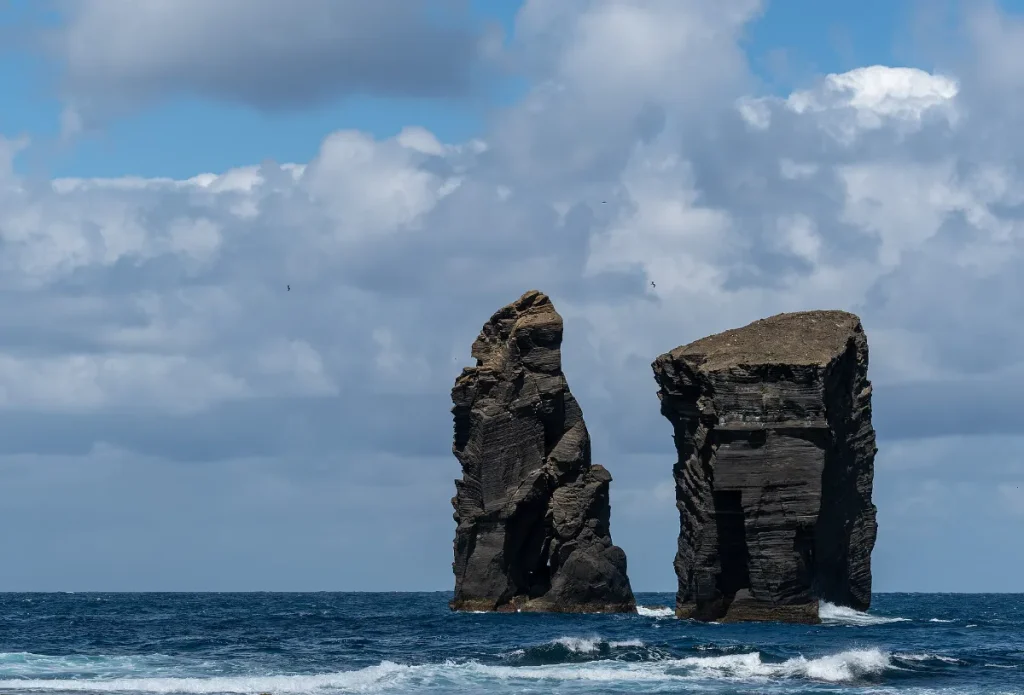
Surfing the Azores: practical info
Surfing
- Level: All levels
- Wave type: Black-sand beach breaks, points and reefs
- Bottom: Volcanic sand on the beaches, cobblestones and volcanic rock on the points and reefs
- When to go: All year
- Best period: October to March for experienced surfers, April to September to learn
- Water temperature: 16 to 23.5°C depending on the month
- Gear: 4/3 and booties in winter, shorty in summer
- Popular spots: Santa Bárbara, Milícias, Monte Verde, Mosteiros, Santa Iria
Before you leave
- Time difference: 1 hour behind London all year (UTC-1 in winter, UTC+0 in summer)
- Flights: About 4 hours direct from Paris CDG with Azores Airlines. Ryanair stopped flying to the Azores on 29 March 2026
- Airport: Ponta Delgada, São Miguel
- Documents: UK citizens: no visa for up to 90 days in any 180, passport issued less than 10 years before arrival and valid 3 months after you leave. EES registration at the border since 10 April 2026. ETIAS is not running yet
- Safety: Strong currents on north-coast beaches when the swell picks up, sharp volcanic rock and sea urchins on the points
- Insurance: Recommended, including repatriation and surf cover
On site
- Language: Portuguese
- Currency: Euro
- Getting around: A rental car is strongly recommended because buses are limited. Allow about €30 to €60 a day
- Between islands: SATA Air Açores flights
- Tourist tax: €2 per person per night, 3 nights maximum, in most São Miguel municipalities
- Electricity: 230 V, European plugs
The best surf spots in the Azores
Most spots are on São Miguel: the north coast from Mosteiros to Santa Iria, and the south coast around Ponta Delgada and Vila Franca do Campo. São Jorge, Terceira and Pico also have waves, more serious and far less crowded.
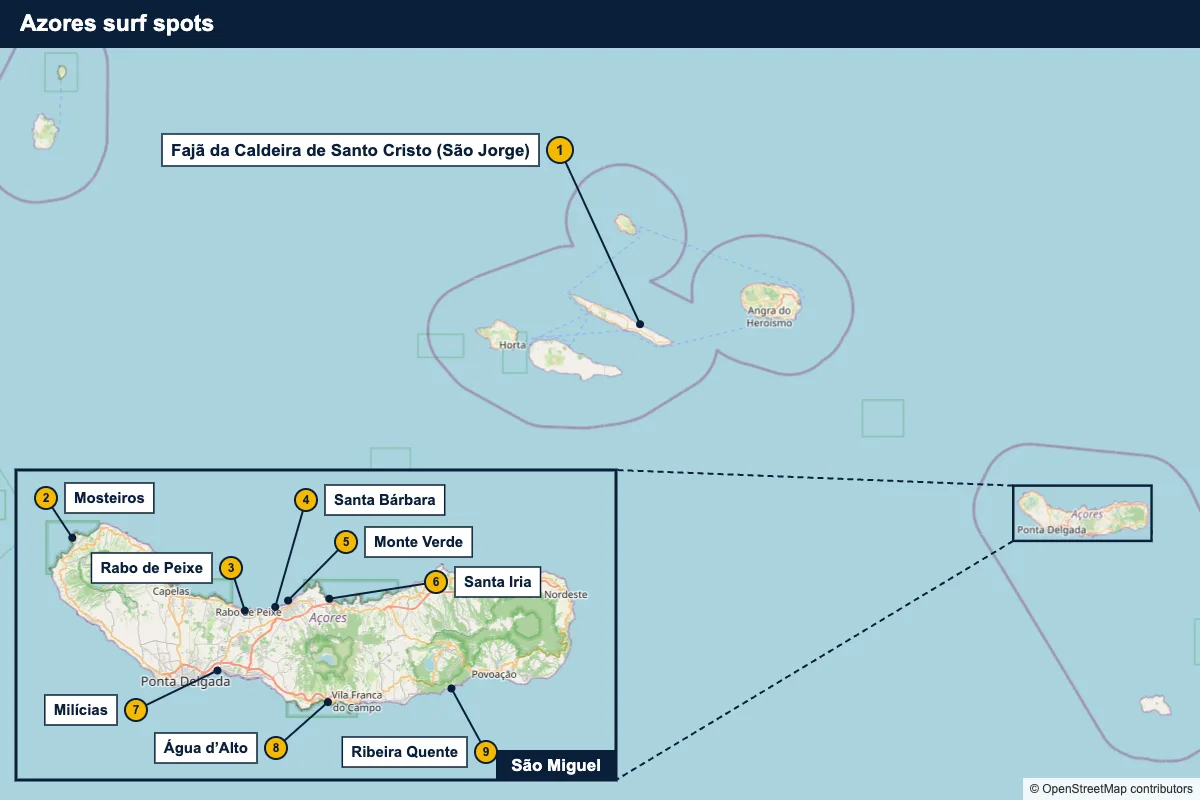
Azores surf spots for beginners
| Spot | Island | The wave | Season |
|---|---|---|---|
| Milícias | São Miguel (south coast) | Black-sand left and right beach break with surf schools, often crowded | April to September |
| Água d’Alto | São Miguel (south coast) | Left and right beach break | South swell |
| Santa Bárbara | São Miguel (north coast) | Sandy left and right beach break, good to learn on small days, currents | October to April |
Azores surf spots for intermediates
| Spot | Island | The wave | Season |
|---|---|---|---|
| Monte Verde | São Miguel (north coast) | Black-sand left and right beach break | Northwest swell |
| Mosteiros | São Miguel (northwest tip) | Right-hand point break over volcanic rock | Winter |
| Santa Iria | São Miguel (north coast) | Left-hand point break over reef, walk-in access | Northwest swell |
Azores surf spots for advanced surfers
| Spot | Island | The wave | Season |
|---|---|---|---|
| Rabo de Peixe | São Miguel (north coast) | Left over reef and boulders, for solid intermediates and up | Winter |
| Ribeira Quente | São Miguel (southeast coast) | Point break over cobbles, for solid intermediates and up | Big south swell |
| Fajã da Caldeira de Santo Cristo | São Jorge | Long lefts and rights off the points | Winter swells |
Azores surf forecast
Wind, gusts and Windguru rating over 7 days on São Miguel:
For other spots: Windguru Ponta Delgada and Windguru Terceira.
Azores surf guides and spot guides
SURFER REVIEWS in the Azores
Have you surfed the Azores? Share your experience. Your review will help surfers of your level plan their trip.
Azores: safety for surfers
In the water
North-coast beaches such as Santa Bárbara have strong currents when the swell picks up. On the points and reefs, the volcanic rock is sharp and there are sea urchins: wear booties. On big winter swells, the north coast is for experienced surfers only.
On land
In summer the road to Lagoa do Fogo is closed to cars during the day and a shuttle runs instead. For getting between spots, a car is still the easiest option.
What to do in the Azores besides surfing
On flat days, the Azores have plenty to offer:
- Sete Cidades: the big crater in the west of São Miguel and its lagoons.
- Furnas: fumaroles, hot springs and the Terra Nostra park.
- Lagoa do Fogo: the crater lake in the middle of the island, with a summer shuttle.
- Whale watching: sperm whales all year, and blue, fin and sei whales mainly from March to June.
- Tea plantations: on São Miguel’s north coast, between two sessions.
All guided activities in the Azores
Budget for a surf trip to the Azores
Here are rough on-the-ground costs (excluding flights):
- Car rental: about €30 to €60 a day
- Group surf lesson: about €40 to €45 for 1.5 to 2 hours, board and wetsuit included
- Tourist tax: €2 per person per night, 3 nights maximum, on São Miguel
The flight is the biggest cost. For board bag fees, read our guide to travelling with a surfboard. For the rest of the country, read our Portugal surf guide.
FAQ: surfing in the Azores
When is the best time to surf the Azores?
October to March for the big north-coast swells, for experienced surfers only. April to September to learn, on the beaches of São Miguel’s south coast.
Can you learn to surf in the Azores?
Yes, mainly at Milícias beach in Ponta Delgada and at Água d’Alto in summer, and at Santa Bárbara on small days. A group lesson costs about €40 to €45.
Do I need a wetsuit in the Azores?
Yes: a 4/3 and booties from December to May, when the water is 16 or 17°C. A shorty is enough from July to October.
Do UK citizens need a visa for the Azores?
No, the Azores are part of Portugal and the Schengen area: up to 90 days in any 180 without a visa. Your passport must be less than 10 years old and valid 3 months after you leave.
How long is the flight to the Azores?
About 4 hours direct from Paris CDG to Ponta Delgada. Ryanair stopped flying to the islands in March 2026.
Which island is best for surfing?
São Miguel for a first trip: it has most of the spots, for every level. São Jorge and Terceira for more experienced surfers.
Do I need to rent a car in the Azores?
Yes, it is strongly recommended: buses are limited and the spots are spread over both coasts. Allow about €30 to €60 a day.
More Atlantic surf destinations
Information may change. This guide is for general guidance only: surf conditions, temperatures, access, opening hours and prices can change. Before your trip and every session, check the forecast, local conditions and information from local providers. A spot description and its suggested level are no guarantee of safety: always match your session to your level and the conditions on the day. Learn more
Updated October 2026
Sources: Surfnerd, mondo.surf, The Surf Atlas, Surfertoday, Rapture Camps, Azores Getaways, Visit Azores, Surfline, Climats et voyages, Weather2Travel, Seatemperatu.re, Azores Airlines, Salt in our Hair, Whale Watching Azores, Gouvernement des Açores, Two Continents, Gov.uk. Map: © OpenStreetMap contributors.