Home » Destinations » Surfing in Portugal » Surfing in the Algarve
Surfing in the Algarve: the spots, the season and our tips
The Algarve stretches all the way to the Spanish border, but for surfing, everything happens between the Alentejo border, Sagres and Lagos. On the west coast, the beaches are in a natural park, with no tall buildings, between cliffs and dunes.
This guide to surfing in the Algarve gives you the right season, the weather month by month, the spots by level and the info to plan your stay, from Faro airport to the rules on vans. For the other regions, read our guide to the surf spots in Portugal.
Why surf in the Algarve?
The west coast of the Algarve is part of the Southwest Alentejo and Vicentine Coast natural park, created in 1988. The beaches lie at the foot of the cliffs, and you go from a sandy beach break to a reef within a few kilometres.
The other advantage is having two coasts. The west coast takes west and northwest swells head-on: it is the one that works most often. The south coast needs a big northwest swell or a south swell, but the north wind blows offshore there. When the west is too big or too windy, you switch coasts.
Surf camp and surf school in the Algarve
A surf camp combines accommodation, lessons and gear: it is the simplest option for a first surf week. In the Algarve, surf camps take their students to the sandy beaches of the west coast. In summer, some schools also go to the south coast. We compared 5 camps, from Sagres to Aljezur, in our selection of surf camps in the Algarve.
Do you run a surf camp in the Algarve?
Present your camp to readers who are planning a surf trip to the Algarve.
List my surf campWhen to go surfing in the Algarve?
It depends on your level and the coast.
- September to November: the best time. The swells are consistent, the water is still mild and there are fewer people than in summer.
- December to March: powerful swells on the west coast, for advanced surfers.
- In spring: smaller waves that are easier to handle.
- June to August: small waves, good for beginners, but lots of people. The south coast is often flat: it is the west coast that works.
The wind often picks up in the late morning: surf early.
Algarve weather month by month
Average air temperatures in Faro (minimum and maximum, IPMA 1991-2020 normals) and average sea temperature in Sagres.
| Month | Air in Faro | Sea in Sagres |
|---|---|---|
| January | 8 to 16 °C | 16 °C |
| February | 9 to 17 °C | 15.5 °C |
| March | 11 to 19 °C | 15.5 °C |
| April | 12 to 21 °C | 16 °C |
| May | 15 to 24 °C | 17 °C |
| June | 18 to 27 °C | 18 °C |
| July | 20 to 29 °C | 18.5 °C |
| August | 20 to 29 °C | 19 °C |
| September | 18 to 26 °C | 19.5 °C |
| October | 16 to 23 °C | 19.5 °C |
| November | 12 to 20 °C | 18 °C |
| December | 10 to 17 °C | 17 °C |
Surfing in the Algarve: practical info
Surf
- Level: all levels, depending on the spot and the coast
- Wave type: sandy beach breaks and a few reefs
- Best time: September to November
- Water: 15 to 16 °C in winter, 19 to 19.5 °C in September-October
- Wetsuit: a 4/3 from autumn to spring, with booties in winter, a 3/2 or a 2 mm in summer
- To learn: a lesson on a sandy beach on the west coast, or on the south side at Sagres on a small swell. Summer is the easiest season.
Before you go
- Airport: Faro, about 116 km from Sagres (1 h 10 by road)
- Without a car: train or bus to Lagos, then the Vamus bus to Sagres
- Documents: ID card or passport for European Union travellers; check entry rules for your nationality
- Currency: euro (€)
- Time: Portugal is on UTC+0 (UTC+1 in summer)
- Insurance: take out insurance that covers surfing
On site
- Getting around: a car is almost essential to switch coasts depending on the swell
- Where to stay: look at Aljezur, Carrapateira, Vila do Bispo or Sagres, close to the spots
- Vans: in the natural park, wild camping and sleeping in a van are banned outside campsites and designated areas
- Safety: currents are the main hazard, especially on a falling tide, and some spots break over shallow reefs
- Forecast: on each surf spot guide
The best surf spots in the Algarve
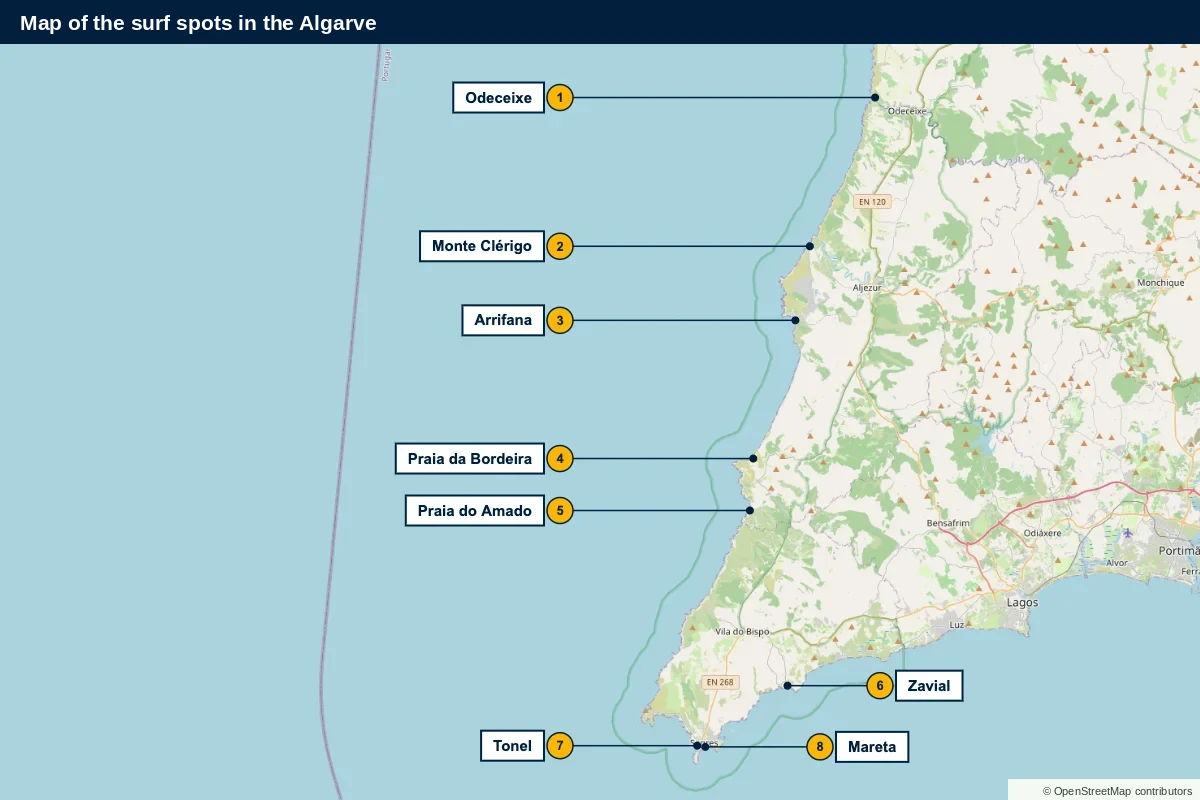
The west coast beaches follow one another from north to south, from Odeceixe to Sagres, at the foot of the cliffs. Around Sagres, you go from the west coast to the south coast in a few minutes. You will mostly find sandy beach breaks and a few reefs. A spot’s level depends on the day’s swell: the tables below give you the main pointers, and each guide gives the details.
Surf spots for beginners in the Algarve
| Spot | Where | When |
|---|---|---|
| Praia do Amado | Carrapateira, west coast | September to June |
| Arrifana | Near Aljezur | Summer |
| Odeceixe | Alentejo border | On small swells |
| Praia do Castelejo | Vila do Bispo | On small swells |
| Martinhal and Mareta | Sagres, south coast | Summer |
Even on these beaches, check the conditions before you paddle out. To compare with the other regions, read our guide to beginner surf in Portugal.
Surf spots for intermediate surfers in the Algarve
| Spot | Where | When |
|---|---|---|
| Praia da Bordeira | Carrapateira, west coast | September to May |
| Praia do Castelejo | Vila do Bispo | When it gets bigger |
| Cordoama | Vila do Bispo | All year round |
| Monte Clérigo | Near Aljezur | Depending on the swell |
| Zavial | South coast | In spring and autumn |
To choose your spot anywhere in the country, read our guide to the surf spots in Portugal for intermediate surfers.
Surf spots for advanced surfers in the Algarve
| Spot | Where | When |
|---|---|---|
| Tonel | Sagres, west coast | Winter |
| Zavial | South coast | November to March |
| Arrifana | In front of the harbour | On a powerful swell |
Surf spot guides in the Algarve
SURFERS’ REVIEWS of the Algarve
Have you surfed in the Algarve? Share your experience.
Marion – beginner surfer
I went surfing in Portugal 3 times (Lisbon, Peniche and Sagres). I loved all 3 destinations but the vibe in Sagres was very pleasant. Not many people in the water, a women-only surf camp and really nice waves. And we saw dolphins 🙂
- September 2023
- Portugal
Algarve or Ericeira for surfing?
The Algarve and Ericeira are two of the best-known regions for a surf trip to Portugal, but the experience is not the same. In the Algarve, you have two coasts: when the west is too big or too windy, you move to the south coast. There are lots of sandy beaches, which helps when you are learning. Ericeira, about fifty kilometres from Lisbon by road, has been a World Surfing Reserve since 2011, with beach breaks to the south and reefs to the north.
The Algarve suits you if you want to vary beaches and learn on sand. Ericeira is a better fit if you are flying into Lisbon and looking for waves to progress on.
What to do in the Algarve besides surfing?
On flat days, or for the people travelling with you:
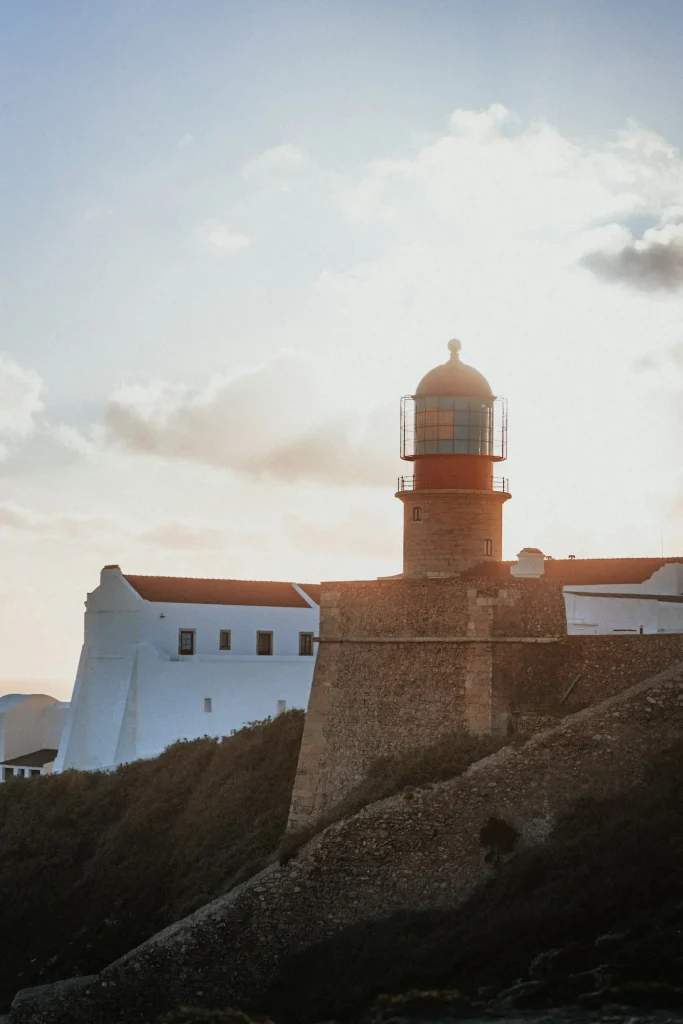
- Cape St. Vincent: the lighthouse stands above 75 m cliffs, and its light can be seen up to about 60 km out to sea (32 nautical miles).
- Sagres fortress: it sits on a headland surrounded by cliffs, with a large wind rose and a walk of about 1.5 km along the cliff edge. It is associated with Henry the Navigator.
- The Rota Vicentina: the Fishermen’s Trail follows the coast, and one section links Sagres to Lagos. The Historical Way, further inland, ends at Cape St. Vincent.
- Ponta da Piedade, near Lagos: limestone cliffs and caves. You can see them by boat or kayak from Lagos, or by going down the 182-step staircase.
All the guided activities in the Algarve
Planning your surf trip to the Algarve
Which coast to pick depending on the swell?
Check the swell and the wind the day before. The west coast takes the swell head-on and works most often. When it is too big or too windy, the south coast, around Sagres and towards Lagos, is often cleaner.
When to go surfing in the Algarve?
September to November for consistent swells and still-mild water. Winter is for advanced surfers, summer for learning, with more people.
Do you need a car?
Pretty much, yes: the spots are spread between Odeceixe, Carrapateira and Sagres, and you often switch coasts. Without a car, buses link Lagos and Sagres.
Can you sleep in a van?
Only on campsites and in designated areas. In the natural park, wild camping and sleeping in a van outside these places are banned.
What wetsuit should you bring?
A 4/3 from autumn to spring, with booties in winter. In summer, a 3/2 or a 2 mm is enough.
Where to take a surf lesson?
On the sandy beaches of the west coast, where the schools go, or on the south side at Sagres in summer. The tables above give you the beaches to learn on.
Other surf destinations in Portugal
Information may change. This guide is for general guidance only: surf conditions, temperatures, access, opening hours and prices can change. Before your trip and every session, check the forecast, local conditions and information from local providers. A spot description and its suggested level are no guarantee of safety: always match your session to your level and the conditions on the day. Learn more
Updated November 2026
Sources: The Surf Atlas, Lonely Planet, Infopédia, Algarve Tourist, Vagamundos, IPMA, Seatemperature.info, Revigorate, Dica de Portugal, Visit Portugal.