Home » Destinations » South Africa
Surfing in South Africa: spots, season and tips
Between the Atlantic and the Indian Ocean, South Africa has waves for every level: the gentle waves of Muizenberg in Cape Town, the beach breaks of the peninsula and the long right-hander of Supertubes in Jeffreys Bay. The water is cool in Cape Town and warmer in Durban.
This guide covers four regions: Cape Town and the peninsula (Muizenberg, Kommetjie), Walker Bay (Hermanus), the Eastern Cape (Jeffreys Bay) and KwaZulu-Natal (Durban). You will find the spots by level, the season, practical info and our tips.
Why surf in South Africa?
In Cape Town, you can learn to surf at Muizenberg, on False Bay: a gentle wave over sand, with board and wetsuit rental facing the beach. On the other side of the peninsula, Long Beach in Kommetjie has faster waves for intermediate surfers. In Jeffreys Bay, the Supertubes right-hander is for advanced surfers only, and in Durban the water stays warm all year round.
East of Cape Town, surfing in Hermanus adds whale watching from the shore, from June to November, to the waves of Voëlklip. Still hesitating with another destination in Africa? Compare with surfing in Morocco and surfing in Senegal.
Surf camp and surf school in South Africa
In Hermanus, Hermanus Surf School offers surf lessons for beginners and intermediate surfers, with accommodation on site and 6-night stays. In Cape Town, there are plenty of surf schools in Muizenberg, with board and wetsuit rental facing the beach.
Do you run a surf camp or a surf school in South Africa?
Present your school to readers planning a surf trip to South Africa.
List my surf campWhen to go surfing in South Africa?
The best season is the southern winter, from June to August: the Southern Ocean swells are more consistent. It is the season for Jeffreys Bay, where Supertubes works best in June and is often flat in summer. In Cape Town, the northwest wind, which dominates in winter, is offshore at Muizenberg; in summer, the southeast wind (the “Cape Doctor”) blows onshore. In Durban, the water stays warm all year round and the town’s spots are consistent.
In winter, the water is colder everywhere: bring a 4/3 in Cape Town. To compare with other destinations, see where to go surfing in June.
The surf season in South Africa by region
| Region | Best time | For beginners | For confident surfers |
|---|---|---|---|
| Cape Town and the peninsula | June to August, with a northwest wind | Muizenberg | Long Beach (Kommetjie) |
| Hermanus (Walker Bay) | With a south to southwest swell; very busy from December to February | Grotto Beach, with a school | Voëlklip |
| Jeffreys Bay (Eastern Cape) | June to August; often flat in summer | No beginner spot in this guide | Supertubes |
| Durban (KwaZulu-Natal) | Warm water all year round | No beginner spot in this guide | New Pier |
Water temperature in South Africa
The water gets warmer from west to east: cool in Cape Town, warmer in Durban.
| Region | Southern summer | Southern winter | Wetsuit |
|---|---|---|---|
| Cape Town, False Bay side (Muizenberg) | Around 20 °C in January | 15 to 16 °C in July | 4/3 in winter, spring suit in summer |
| Hermanus | 19 to 21 °C in February | 15 to 16 °C in July | Wetsuit recommended |
| Jeffreys Bay | 20 to 23 °C in February | 18 to 19 °C in July | Wetsuit recommended |
| Durban | Around 26 °C in February | Around 21 °C in August | Rash vest in summer, shorty or 3/2 in winter |
Surfing in South Africa: practical info
Surf
- Level: all levels depending on the spot and the season
- Wave type: beach breaks, reefs and points
- Water: 15 to 20 °C in Cape Town, 18 to 23 °C in Jeffreys Bay, 21 to 26 °C in Durban
- Wetsuit: 4/3 in winter in Cape Town; rash vest in summer in Durban
Before you go
- Flights: Air France flies direct between Paris and Johannesburg all year round; from 22 September 2026 to 27 March 2027, it also flies direct between Paris and Cape Town, 5 times a week from November
- Airports: Cape Town (Muizenberg, Kommetjie, Hermanus), Gqeberha, formerly Port Elizabeth, 75 to 90 km from Jeffreys Bay, and Durban
- Entry requirements: many nationalities, including British and French citizens, need no visa for a tourist stay of up to 90 days; your passport must be valid for 30 days after you leave the country, with two blank pages. Check the rules for your own passport. Since 1 July 2026, an online declaration of goods and currency is mandatory
- Safety: read the UK travel advice for South Africa before you go
On site
- Currency: South African rand (ZAR)
- Time zone: UTC+2 all year round, no daylight saving time
- Sharks: in Cape Town, Shark Spotters watch eight False Bay beaches, including Muizenberg all year round: a white flag with a black shark means a shark is in the area, and a siren sounds when a great white comes close to the surfers, so get out of the water. In KwaZulu-Natal, some beaches are protected by shark nets, removed in winter during the sardine run
- Wind: in Cape Town, in summer, the southeast wind (the “Cape Doctor”) blows hard
Where to surf in South Africa: the spots
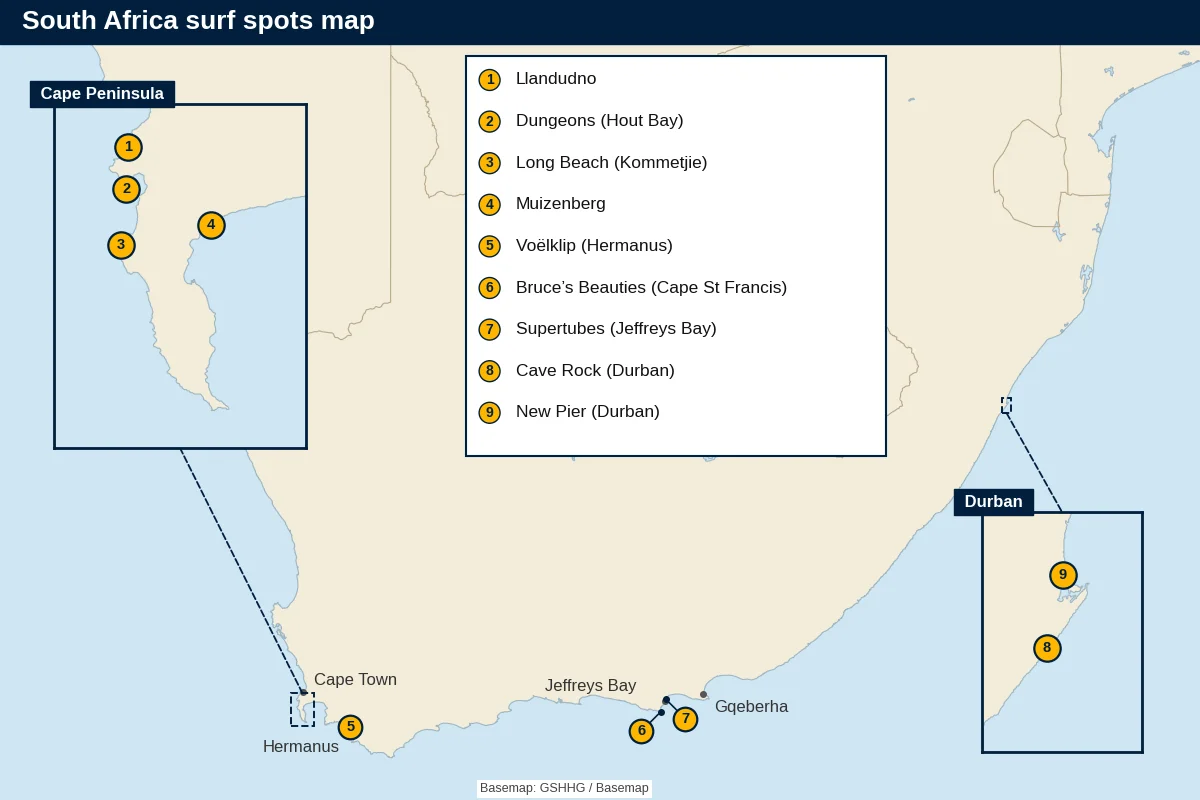
The spots in this guide are spread over three coasts: the Atlantic and False Bay around Cape Town, the south coast (Hermanus, Jeffreys Bay) and the Indian Ocean in Durban. The map shows them from west to east. Choose your region according to the season, then your spot according to your level.
Surf forecast for South Africa
Before each session, check the swell, the wind and the tide. In Cape Town, also look at the shark spotters’ flag.
- Muizenberg: Windy map for Muizenberg
- Kommetjie: Windy map for Long Beach
- Hermanus: Windy map for Voëlklip
- Jeffreys Bay: Windy map for Supertubes
- Durban: Windy map for New Pier
Surf spots in South Africa for beginners
| Spot | Where | The wave | When |
|---|---|---|---|
| Muizenberg | Cape Town, False Bay side | Sandy beach break, gentle rights and lefts; rental facing the beach | In winter, with a northwest wind; smaller waves in summer |
| Grotto Beach | Hermanus | Long Blue Flag sandy beach; schools give lessons here, with sheltered areas to learn | Bigger waves in winter |
Surf spots in South Africa for intermediate surfers
| Spot | Where | The wave | When |
|---|---|---|---|
| Llandudno | Cape Town, Atlantic coast | Sandy beach break, three peaks; the right near the rocks (The Gat) can be hollow; localism | West to southwest swell, southeast wind |
| Long Beach | Kommetjie, Cape Peninsula | Beach break, fast right and left peaks; shore break on big days | West to southwest swell, south wind; low to mid tide |
| Voëlklip | Hermanus | Reef and rocks, short and hollow rights; sea urchins | South to southwest swell, north wind |
Surf spots in South Africa for advanced surfers
| Spot | Where | The wave | When |
|---|---|---|---|
| Supertubes | Jeffreys Bay | Fast and hollow right point break, over rock and sand; sharks | June to August, south to southwest swell, west to southwest wind |
| Dungeons | Hout Bay, Cape Town | Big offshore reef wave, for big-wave specialists; access by boat or jet ski from Hout Bay harbour | Late winter, with the big swells of cold fronts |
| Bruce’s Beauties | Cape St Francis, near Jeffreys Bay | Fast and hollow right point break, over rocks; rarely works | East to southeast swell, southwest wind; low to mid tide |
| Cave Rock | Durban (Bluff) | Hollow and powerful right over reef; currents | Southwest swell, west to northwest wind |
| New Pier | Durban | Fast wave along the pier, rights and lefts over sand; intermediate surfers on small days only; peak held by locals | With a south swell, west wind |
South Africa surf spot guides
SURFERS’ REVIEWS of South Africa
Have you surfed in South Africa? Share your experience.
Cape Town, Hermanus, Jeffreys Bay or Durban?
The four regions do not suit the same level: choose according to your level and the water temperature.
Cape Town and the peninsula
To learn at Muizenberg and improve at Long Beach. The water is cool: bring a 4/3 in winter. It is all in our Muizenberg and Long Beach guides.
Hermanus (Walker Bay)
Voëlklip, the best-known spot in town, breaks over reef and rocks. From June to November, you can see whales from the shore. It is all in our Hermanus guide.
Jeffreys Bay (Eastern Cape)
For advanced surfers, from June to August, with Supertubes. It is all in our Supertubes guide.
Durban (KwaZulu-Natal)
To surf in warm water all year round. New Pier, the best-known wave in town, is very crowded and for confident surfers only.
What to do in South Africa besides surfing?
On flat days, each region has its outings:
- The Boulders penguins (Cape Town): in Simon’s Town, on False Bay, a colony of African penguins, an endangered species. You watch them from three wooden boardwalks, in Table Mountain National Park
- Cape Point and the Cape of Good Hope: at the tip of the peninsula, cliffs above the Atlantic and viewpoints. Do not feed the baboons: they can open car doors
- The Dungeons surfers: on very big swell days in late winter, boats leave Hout Bay harbour to watch the big-wave surfers, as the wave cannot be seen from the beach
- Whales in Hermanus: from June to November, southern right whales come to calve in Walker Bay. You see them from the cliff path that runs along the bay
- Addo Elephant National Park: about 72 km from Gqeberha, to combine with a stay in Jeffreys Bay
- The Durban beachfront: the promenade runs from Addington Beach to Blue Lagoon, about 2 hours on foot. Along the way, the uShaka Marine World aquarium and snorkelling at Vetch’s Pier
All guided activities in South Africa
FAQ: surfing in South Africa
Where to surf in South Africa?
In Cape Town (Muizenberg, Long Beach in Kommetjie, Llandudno), in Hermanus (Voëlklip, Grotto Beach), in Jeffreys Bay (Supertubes) and in Durban (New Pier, Cave Rock).
When to go surfing in South Africa?
In the southern winter, from June to August, for the swells. In Durban, the water stays warm all year round.
Where to learn to surf in South Africa?
At Muizenberg, in Cape Town: a sandy beach break with a gentle wave and rental facing the beach. In Hermanus, at Grotto Beach, with a school.
Is Supertubes suitable for beginners?
No. It is a fast right point break over a rock bottom, for advanced surfers only.
Do you need a wetsuit to surf in South Africa?
Yes in Cape Town: a 4/3 in winter, when the water drops to 15 to 16 °C. In Durban, a rash vest is enough in summer.
Do you need a visa for South Africa?
Not for many nationalities, including British and French citizens, for a tourist stay of up to 90 days. Your passport must be valid for 30 days after you leave the country and have two blank pages. Check the rules for your own passport.
Are there sharks in South Africa?
Yes. In Cape Town, Shark Spotters watch eight False Bay beaches, including Muizenberg all year round, with a flag system and a siren. In KwaZulu-Natal, some beaches are protected by shark nets.
More surf destinations in Africa
Information may change. This guide is for general guidance only: surf conditions, temperatures, access, opening hours and prices can change. Before your trip and every session, check the forecast, local conditions and information from local providers. A spot description and its suggested level are no guarantee of safety: always match your session to your level and the conditions on the day. Learn more
Updated November 2026
Sources: Surfline, Surf-forecast, Wannasurf, The Surf Atlas, Cape Town Magazine, Surfnerd, South Africa Tourism, Zigzag, World Beach Guide, SANParks, Fodor’s, Fora Travel, GOV.UK, World Travel Guide, Original Travel, ATTA, Time Out, Press Portal, Travel Dojo, Whale Coast, Shark Spotters, KZN Sharks Board, Seatemperature.net, Weather-stats, Nova News, France Diplomatie.
Photos: Unsplash (Stephen Coetsee, Vlad Pavlov, Sincerely Media, Ceeces Travel, Spekboom, Matthias Wesselmann). Map: GSHHG / Basemap.