


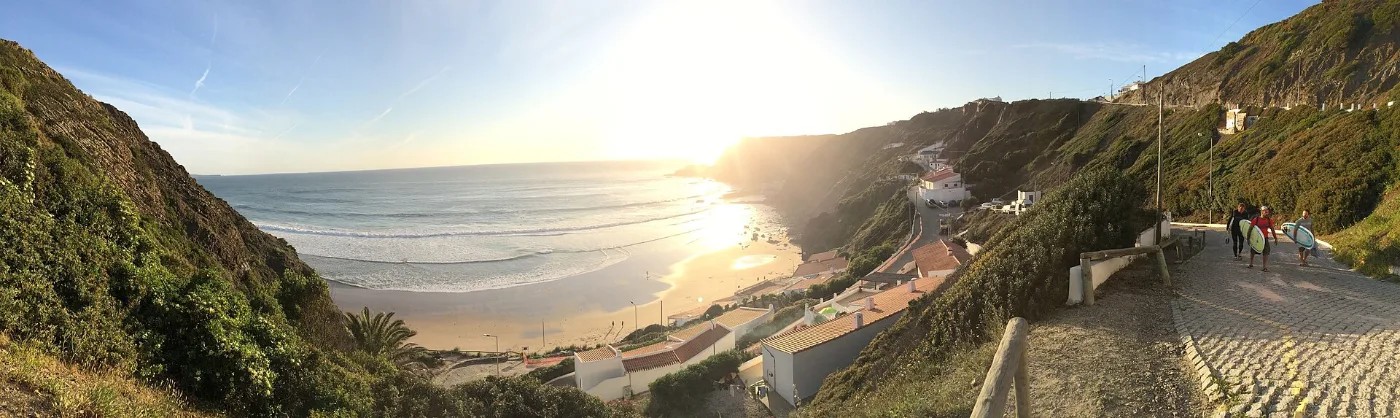
Arrifana is a bay at the foot of the cliff, about ten minutes from Aljezur, on the west coast of the Algarve. There are two waves: a sandy beach break, where people learn, and in front of the small harbour, at the north end of the bay, a fast, hollow reef right. For the other spots in the region, read our guide to the surf spots in the Algarve. If you are a beginner, also read our guide to beginner surf in Portugal.
In short: Arrifana
| Wave type | Beach break and reef, rights and lefts on the beach break, a right on the reef |
| Bottom | Sand and reef |
| Best tide | All tides except high, when the beach closes out; to the north, best around low tide |
| Swell direction | Northwest and west |
| Best wind | Northeast |
| Wave length | Check on site |
| Best level | Beginner to intermediate on the beach break, advanced on the reef |
| Best season | Autumn |
| Water temperature | 15 to 19 °C depending on the season |
| Good to know | Shallow reef, broken boards are common. The beach break closes out when the winter swell is big. Parking is difficult in summer. |
Arrifana surf spot (Algarve)
The spot works with a northwest swell and a northeast wind. The bay faces southwest: it picks up west and northwest swells. The reef only works with a fairly strong swell.
Video: Arrifana in pictures
When to surf Arrifana?
Arrifana works all year round. Autumn is the best season. In summer, the waves are smaller, good for beginners, but there are a lot of people in the water. In winter, big swells can make the beach too big to surf, and that is reef season.
Arrifana surf calendar: intensity by month
Arrifana forecast
Before you go, check the day’s conditions:
- Surf-Forecast for Arrifana: swell, wind and tide.
- Windy weather map (37.2924, -8.8648): swell, wind and weather, live.
- Windguru has no station at Arrifana: the forecast below is for Carrapateira, a little further south (wind, gusts, swell and rating over 7 days).
Arrifana: which surfing level?
Beginners: yes, on the beach break
The sand and the whitewater are easy in summer, when the swell drops. The schools in the region give lessons here.
Intermediate: yes on a medium swell
The beach break gives you rights and lefts to progress on. Avoid the middle of the beach when it gets bigger: the waves close out.
Advanced: the reef in front of the harbour
It takes a fairly strong swell for the right to break. It is fast and hollow, over a shallow reef: broken boards are common here.
How to get to Arrifana
From Aljezur, it is about ten minutes by car to the beach. In summer, parking can be difficult.
There are cafés and holiday rentals near the beach.
Spot location
GPS coordinates: 37.2924° N, 8.8648° W. West coast of the Algarve, near Aljezur.
Open the full map on OpenStreetMap
Which surf camp to surf Arrifana?
There are surf camps around Arrifana and Aljezur. We compared several of them in our Algarve surf camp guide.
Where to stay near Arrifana?
The closest accommodation is in Arrifana and Aljezur.
What to do near Arrifana?
Further north, Odeceixe is another sandy beach, on the border with the Alentejo. To the south, towards Carrapateira, you will find Praia da Bordeira and Praia do Amado.
FAQ: Arrifana (Algarve)
Yes, on the sandy beach break, especially in summer when the swell is small. The reef in front of the harbour is for good surfers.
Autumn. The spot works all year round, but in summer it is crowded and in winter the beach can be too big.
At the north end of the bay, in front of the small harbour. It is a fast, hollow right over a shallow reef.
By car: the beach is about ten minutes from Aljezur. In summer, allow time to park.
For the rest of the country, see our map of surf spots in Portugal.
Sources: The Surf Atlas, Surf-forecast, Lonely Planet, Seatemperature.info.