Home » Destinations » France
Surfing in France
From the big beach breaks of the Landes to the reefs of the Basque Country, with the beaches of Gironde and the points of Brittany in between, France has waves for every level. Surfing arrived in Biarritz at the end of the 1950s, and the Atlantic coast now has surf schools, well-known spots and competitions.
This guide takes you through surfing in France region by region: the level, the season and the spots to know, with a link to our full guide for each region.
Why surf in France?
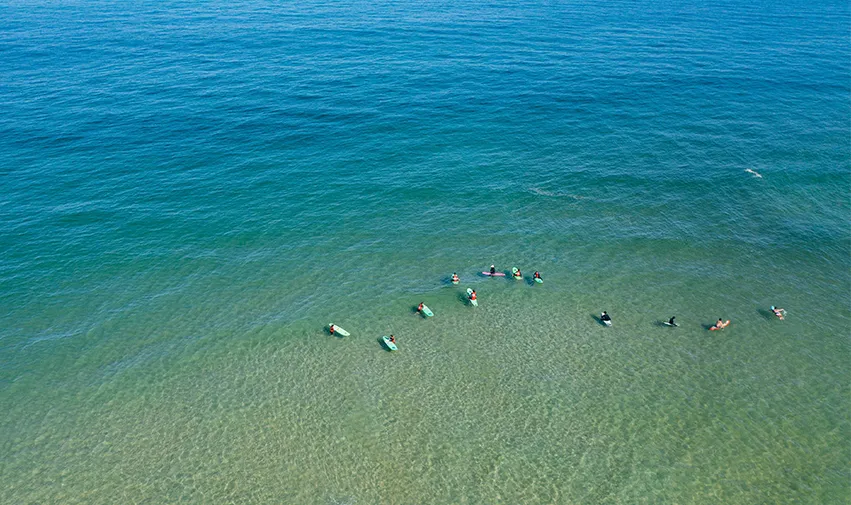
Surfing has deep roots in France. Its strength is variety: sandy bottoms in the Landes and Gironde, reefs and points in the Basque Country and Brittany. Depending on your level, you can learn in the whitewater of a big beach or look for hollower waves a few kilometres away.
- Surf schools on the main beaches of the Atlantic coast.
- Waves for every level, often a few minutes apart.
- A long surf culture: surfing arrived in Biarritz in 1956-1957, and Hossegor, Seignosse and Capbreton host the Quiksilver Festival in September.
- Swell all year round: smaller in summer, bigger in autumn and winter.
Our surf camp picks
Surfing in France: practical information
Surf
- Level: all levels depending on the spot
- Wave type: beach breaks, reefs and points
- Bottom: mostly sand (Landes, Gironde), sand and reef (Basque Country, Brittany)
- Swell: west to northwest on the Atlantic coast
- Water: about 12 to 14 °C in winter and 21 to 23 °C in summer in the Southwest, colder in Brittany
Before you go
- Time difference: none from Paris
- Airports: Biarritz (Basque Country and southern Landes), Bordeaux (Gironde), Brest and Quimper (Brittany)
- Train: TGV to Biarritz, Saint-Jean-de-Luz, Hendaye, Bayonne or Dax, then a bus to the beaches
- Documents: ID card or passport for European Union travellers
On site
- Language: French, English in tourist areas
- Currency: euro (€)
- Safety in the water: baïnes and currents on sandy beaches; follow the flags and surf in the marked zone (black and white chequered flag)
- Getting around: a car is the easiest way to change spots; some towns run beach shuttles in summer
When to go surfing in France?
The right time depends on your level. West to northwest swells are more regular and bigger in autumn and winter: that is the season for advanced surfers. In spring and summer, the waves are usually smaller and the water warmer, which suits beginners better, with more people in the water.
For the month-by-month details by level, read our guide on when to go surfing in France.
Where to surf in France for your level?
Picking the right spot is the key to improving without scaring yourself.
To start
- Hendaye (Basque Country): a big sandy beach in a bay, with smaller waves than elsewhere on the coast.
- The Côte des Basques (Biarritz): a sandy spot for beginners and intermediates, known for longboarding.
- Vieux-Boucau and Moliets (Landes): beach breaks where surf schools take their students in summer.
- La Torche (Brittany): a spot for every level, especially when it is small.
To improve
- Le Penon and Les Estagnots (Seignosse): beach breaks with several peaks for intermediate and advanced surfers.
- Lacanau (Gironde): several peaks along a long beach.
- Les Cavaliers (Anglet) and Lafitenia (Saint-Jean-de-Luz): more demanding waves, over sand or sand and reef.
For advanced surfers
- La Gravière (Hossegor): a hollow, powerful beach break for experienced surfers only.
- La Nord (Hossegor): a big-wave spot.
- Belharra (off Saint-Jean-de-Luz): a giant wave 2.5 to 3 km offshore, for experts only.
The Basque Country: where surfing arrived in France
Surfing arrived in France in Biarritz: in 1956, during the filming of “The Sun Also Rises”, Peter Viertel surfed at the Côte des Basques, and the first surf club was founded in 1959. The Basque coast mixes sandy beaches and reefs, which gives waves for every level within a few dozen kilometres.
- To start: Hendaye, the Côte des Basques in Biarritz, Bidart.
- To improve: Les Cavaliers in Anglet, Lafitenia in Saint-Jean-de-Luz.
- For advanced surfers: Parlementia in Guéthary on a big swell, and Belharra for experts.
The spots town by town are in our guide to surfing in the Basque Country. See also our guides to surfing in Biarritz and surfing in Hendaye.
The Landes: the beach break coast
The Landes are 106 km of sandy beaches lined by pine forest. The sandbanks move with the seasons and create peaks everywhere, with the best conditions on a west to northwest swell and an east wind. Watch out for baïnes, the dips between sandbanks that create currents out to sea.
- To start: Vieux-Boucau, Moliets, and La Sud in Hossegor with a surf school.
- To improve: Le Penon and Les Estagnots in Seignosse, Capbreton.
- For advanced surfers: La Gravière and La Nord in Hossegor, La Piste in Capbreton.
All the spots, the season and our tips are in our guide to surfing in the Landes. See also our guide to surfing in Capbreton.
Gironde: long sandy beaches
From Soulac to Cap Ferret, Gironde is long sandy beaches facing the Atlantic, with several peaks on each beach. As in the Landes, baïnes create currents: surf in the lifeguarded zones when you are a beginner.
- Lacanau-Océan: the best-known spot, which hosts the Lacanau Pro, a stop on the WSL European tour, in July.
- Le Porge, Carcans and Hourtin: quieter beaches a few kilometres away.
- Cap Ferret: sandbanks on the ocean side, with currents to respect.
Vendée
Further north, Vendée also has its spots, from Brétignolles-sur-Mer to Saint-Gilles-Croix-de-Vie. Our Vendée guide is coming soon.
Brittany: the most exposed spots
Brittany picks up west to northwest swells, and you can surf there all year round. The best-known spot is La Torche, in Plomeur: a beach facing due west, open to every level when it is small, which works on all tides.
- La Torche: all levels, crowded when it is good.
- The Baie des Trépassés: a beach break that works on the rising tide, with strong currents.
- Le Petit Minou (near Brest): a beach break with a reef point, at low tide.
SURFER REVIEWS
Have you surfed in France? Share your experience.
Your feedback will help surfers at your level plan their trip.
Fanny – intermediate level
I surf all year round in the south of the Landes, especially at Santocha in Capbreton. I love this spot but it is demanding and temperamental. In winter it is a fallback spot for surfers from Seignosse and Hossegor. In summer the waves are ideal for beginners but watch out for the crowds.
- All year round
- Capbreton, France
Muriel – beginner level
Great experience at Santocha! I am a beginner surfer and I took lessons in Capbreton (Santocha). In summer there are inevitably quite a few people in the water, but the lessons are really great and so are the instructors: good teachers, reassuring and motivating. I recommend it!
- All year round
- Capbreton, France
Eric – upper intermediate
Very surfable spot depending on the area, at all tides, rather nice atmosphere but it is getting worse, so let’s respect all the safety and priority rules to share the waves as well as possible. They are easy to find and understand, and if needed ask at the spot. Have a good surf!
- All seasons except December, January and February
- Hendaye
Planning your surf trip to France
What is the best time to surf in France?
It depends on your level. Swells are more regular and bigger in autumn and winter, the season for advanced surfers. In spring and summer, the waves are usually smaller and the water warmer: the easiest time to start. The month-by-month details are in our guide on when to go surfing in France.
Where to start surfing in France?
Sandy beaches with surf schools: Hendaye and the Côte des Basques in the Basque Country, Vieux-Boucau and Moliets in the Landes, La Torche in Brittany when it is small. Take a lesson and surf in the zone marked by the lifeguards.
Do you need a wetsuit to surf in France, and which one?
Yes, all year round on the Atlantic coast. In the Southwest, a shorty or a 2 mm is enough in midsummer (water around 21 to 23 °C). In winter, the water drops to around 12 to 14 °C: bring at least a 4/3, and in the coldest months a 5/4 or 5/3 with booties, gloves and a hood. In Brittany, the water is colder.
Can you surf in Brittany?
Yes, all year round. Brittany picks up west to northwest swells well. La Torche, in Plomeur, is the best-known spot, open to every level when it is small. The water is colder than in the Southwest: bring a thicker wetsuit.
Can you surf on the French Mediterranean?
Yes, when there is wind and swell, but conditions are rarer and less regular than on the Atlantic. We explain where and when in our article on surfing in the Mediterranean.
How long does it take to learn to surf?
It depends on how often you surf and on your fitness. On a one-week course, most beginners manage to stand up and ride in the whitewater. To surf green waves and turn, count on several months of regular practice. Our tips are in our beginner surfing guide.
Which board to choose to start surfing in France?
A long, high-volume foam board: it floats, it is stable and it won’t hurt you when you fall. Most schools and rental shops on the beaches have them. Move on to a shorter board once you catch waves on your own.
Information may change. This guide is for general guidance only: surf conditions, temperatures, access, opening hours and prices can change. Before your trip and every session, check the forecast, local conditions and information from local providers. A spot description and its suggested level are no guarantee of safety: always match your session to your level and the conditions on the day. Learn more
Updated November 2026
Sources: Surfline, Lonely Planet, Routard, Google Arts & Culture, Seignosse Tourisme, Actunautique, Saint-Jean-de-Luz Tourist Office, Tourisme Bretagne, Seatemperatu.re, Surf-forecast, Service-public.fr, Tourisme Biarritz.