Accueil » Destinations » Canary Islands » Fuerteventura
Surfing in Fuerteventura: complete guide to spots and tips
Fuerteventura is the most surf-focused of the Canary Islands. Golden sand beaches, dunes, lava reefs and wind almost every day. Most of the waves are in the north, between Corralejo, Majanicho and El Cotillo: you can learn at Flag Beach in the morning and watch good surfers get barrelled at El Hierro in the afternoon. Also read our complete guide to surfing in the Canary Islands.
In short: surfing in Fuerteventura
| Level | All levels depending on the spot: Flag Beach, Playa del Moro and El Cotillo in summer to learn, Rocky Point and Majanicho to progress, El Hierro, Bristol and Lobos for experienced surfers |
| Best season | October to March for north and northwest swells. From April to September, smaller waves and stronger trade winds: good for learning |
| Water temperature | Around 18 °C from February to April, 22 to 23 °C from August to October |
| Wetsuit | 3/2 mm from December to April, 2 mm or shorty in summer. Booties recommended on the reefs |
| Wind | The northeast trade winds often blow hard, especially in summer: mornings are usually the best time |
| Getting there | Fuerteventura airport, near Puerto del Rosario, with direct flights from many European cities. A car helps to move between Corralejo and El Cotillo |
Why surf in Fuerteventura?
Fuerteventura gets the same swells as Lanzarote, with many spots packed into the north of the island, a few kilometres apart. Corralejo for the buzz and the surf schools, Lajares and El Cotillo for a slower pace. You can surf Rocky Point, have fish for lunch at El Cotillo harbour, then watch the sunset over the Corralejo dunes.
The island is easy to organise: short flights from Europe, affordable car hire and everyday prices on the low side. Want to combine several islands? See how to travel between the Canary Islands. Lanzarote is about 30 minutes away by ferry from Corralejo.
Surf camp in Fuerteventura
Most surf camps and surf schools in Fuerteventura are in the north, in Corralejo, Lajares and El Cotillo. The idea is the same everywhere: accommodation, lessons, equipment and transport to the spot of the day, chosen according to swell and wind. It is the easiest way to learn, since the instructors know where to go when it gets too big.
Average price: €300 to €600 a week in a surf camp depending on the package. Group lesson: around €50 for a half day. Board rental: €15 to €20 a day.
Where to stay to surf in Fuerteventura?
Corralejo: the biggest town in the north, with surf shops, restaurants and nightlife. Flag Beach and Rocky Point are within walking distance, and the boat to Lobos leaves from the harbour.
Lajares: a surfers’ village between the north and west coasts, a few minutes from Majanicho and El Cotillo. Quieter, with cafés and yoga.
El Cotillo: a fishing village facing the sunsets, next to Piedra Playa and the lagoons.
“We stayed at the Bahiazul resort, a 3-bedroom villa with a pool near Corralejo. Everything was there to rest well.” Alice and Lucie
Hesitating with the neighbouring island? Read our comparison of surf camps in Lanzarote.
Do you run a surf camp in Fuerteventura?
Present your camp to readers planning a surf trip to Fuerteventura.
List my surf campWhen to surf in Fuerteventura?
You can surf in Fuerteventura all year round, but conditions change a lot with the seasons. Wind matters as much as swell: the northeast trade winds often blow hard, especially in summer, and the best sessions are usually early in the morning.
Winter (October to March): wave season
North and northwest swells hit the north and west coasts. The reefs of Majanicho, El Hierro and Bristol wake up, Lobos can peel for several hundred metres and El Cotillo turns into a hollow beach break. This is the season for intermediate and experienced surfers. To compare with other destinations, see the best December surf destinations and the best January surf destinations.
Summer (April to September): small waves to learn
Swells are smaller and the reefs often flat, but El Cotillo and Flag Beach keep small waves, and northeast wind swells bring Playa del Moro to life. It is the right time to learn. September is often a good compromise, with the first autumn swells and 23 °C water: see the best September surf destinations.
Water temperature and wetsuit
The water drops to around 18 °C from February to April and rises to 22 or 23 °C between August and October. A 3/2 mm is enough in winter. In summer, a 2 mm or a shorty will do. Bring booties for the reefs.
Fuerteventura weather month by month
Fuerteventura airport records (1981 to 2010 averages): average air temperatures (minimum and maximum) and number of rainy days, with the water temperature in Corralejo.
| Month | Air | Water | Rainy days |
|---|---|---|---|
| January | 15 to 21 °C | 19 °C | 3 |
| February | 15 to 21 °C | 18 °C | 2 |
| March | 16 to 22 °C | 18 °C | 2 |
| April | 16 to 23 °C | 18 °C | 1 |
| May | 17 to 24 °C | 19 °C | 0 |
| June | 19 to 26 °C | 20 °C | 0 |
| July | 21 to 27 °C | 21 °C | 0 |
| August | 22 to 28 °C | 22 °C | 0 |
| September | 21 to 28 °C | 23 °C | 1 |
| October | 20 to 26 °C | 22 °C | 2 |
| November | 18 to 24 °C | 21 °C | 2 |
| December | 16 to 22 °C | 20 °C | 3 |
Surfing in Fuerteventura: practical information
Surfing
- Level: All levels
- Wave types: Beach breaks at Flag Beach and El Cotillo, reef and point breaks on the north coast and at Lobos
- Bottom: Sand, volcanic rock
- When to go: All year round
- Best period: October to March for waves, April to September to learn
- Average water temperature: Around 18 °C from February to April, 23 °C in September
- Average air temperature: Between 21 °C and 28 °C during the day depending on the season
- Equipment: 3/2 mm wetsuit in winter, 2 mm or shorty in summer, booties for the reefs
- Popular spots: Flag Beach, Rocky Point, Majanicho, El Hierro, El Cotillo, Lobos
Before you leave
- Time zone: Same as the UK, 1 hour behind France
- Airport: Fuerteventura, near Puerto del Rosario
- Documents: Valid ID card or passport for EU citizens
- Vaccinations: None required
- Surfboard luggage: Extra fee depending on the airline, check before booking
On site
- Language: Spanish (English widely spoken in tourist areas)
- Currency: Euro (€)
- Cost of living: Moderate
- Safety: A safe island for travellers
- Getting around: Car hire recommended, buses are not practical for following the spots
- Ferry: Corralejo to Playa Blanca (Lanzarote) in about 30 minutes
The best surf spots in Fuerteventura
Almost all of Fuerteventura’s surf spots are in the north of the island, on three coasts: Corralejo bay to the east, the north shore around Majanicho, and the west coast around El Cotillo. They are less than 30 minutes’ drive from each other, so each day you can pick the coast that works best with the wind. The south of the island, around Sotavento, is mostly a kitesurf and windsurf area. Here are the spots by level, with the tide that suits them best.
Learning to surf in Fuerteventura
For your first waves, go to Flag Beach, south of Corralejo, or to El Cotillo in summer when the swell is small. Wear booties at Flag Beach because of the rocky patches, and stay in the surfing zone: surfing is banned in front of the hotels. Almost all the other spots in the north break over volcanic rock.
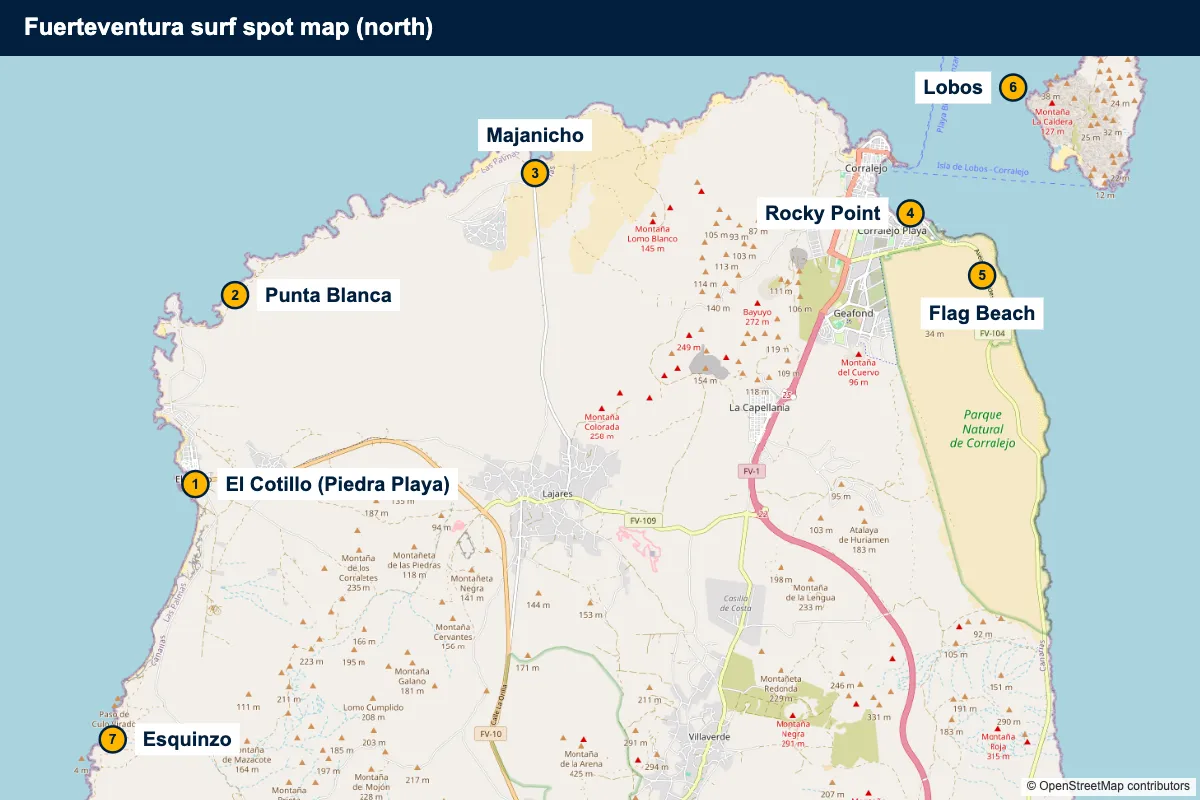
Surf spots in Fuerteventura for beginners
| Spot | Where | The wave | Tide |
|---|---|---|---|
| Flag Beach | South of Corralejo, start of the Grandes Playas | Sand and rock beach break, lefts and rights, surf schools on site. Booties recommended | All tides, better on the rising tide according to Surfnerd |
| Playa del Moro | Grandes Playas, south of Corralejo | Easy beach break with plenty of whitewater. Works with northeast wind swells, so often in summer. Crowded in high season | Not stated by our sources |
| El Cotillo (summer) | Piedra Playa, south of El Cotillo village | Sand beach break, A-frame peaks. Easy in summer in small swells with a school, powerful and hollow in winter | All tides |
In summer, the surf schools of Corralejo and El Cotillo choose between these beaches depending on the wind and swell of the day.
Surf spots in Fuerteventura for intermediates
| Spot | Where | The wave | Tide |
|---|---|---|---|
| Rocky Point (Punta Elena) | In front of Corralejo, walkable | Reef, fast hollow right and longer left. Rocks on the inside, long paddles when it is big | All tides, better on the rising tide according to Surfnerd |
| Majanicho | Small harbour of Majanicho, north coast | Long, fairly soft reef right peeling along the harbour. Sharp reef, currents in big swells | All tides, better on the rising tide according to Surfnerd |
| Punta Blanca | North coast, along the Majanicho track | Reef, fairly soft A-frame with a channel to paddle back out. Currents and urchins | Not stated by our sources |
| Esquinzo | West coast, south of El Cotillo | Reef and sand, powerful left with long walls in northwest swells. Heavy and unpredictable at low tide | Mid to high tide according to The Surf Atlas |
Surf spots in Fuerteventura for experienced surfers
| Spot | Where | The wave | Tide |
|---|---|---|---|
| El Hierro (The Bubble) | West of Majanicho, north coast (not the island of El Hierro) | Volcanic reef, fast and hollow A-frame: powerful left, shorter right that barrels. Committing take-off, crowded in winter | Around high tide according to Hello Canary Islands |
| Bristol | North coast, west of Corralejo | Shallow lava reef, mostly lefts with long walls, barrels in big swells. Localism | Not stated by our sources |
| Lobos | West coast of Lobos island, by boat from Corralejo | Long right-hand point break over a lava reef, one of the longest waves in the Canaries. Localism | All tides, better on the rising tide according to Surfnerd |
On these reefs, wear booties and respect priority: there are plenty of locals when it is working.
Fuerteventura forecast
Wind, gusts and Windguru rating over 7 days at Flag Beach:
To follow the swell spot by spot: Surf-Forecast (Majanicho) and Surfnerd (Rocky Point).
SURFER REVIEWS in Fuerteventura
Have you surfed in Fuerteventura? Share your experience.
Your feedback will help surfers of your level prepare their trip.
Aurélie – intermediate level
Surfed at La Pared, quite powerful but the place is beautiful. A bit of exercise to climb down the rocks to reach the beach, but it makes a good warm-up.
- December 2017
- Fuerteventura
Fuerteventura, Lanzarote or Tenerife?
The three islands get the same winter swells, but the experience on the ground is very different.
Fuerteventura
The 100% surf choice. Lots of spots packed into the north, from Flag Beach to Lobos, huge beaches and wind. Ideal if you want to surf every day and switch coasts with the conditions.
Lanzarote
Just to the north, about 30 minutes by ferry. Wilder and quieter, with Famara to learn and serious reefs around La Santa. Read our guide to surfing in Lanzarote.
Tenerife
Bigger, greener and livelier, with spots in the south and the north. Handy if you want to mix surfing, hiking and nights out. Everything about surfing in Tenerife.
What to do in Fuerteventura besides surfing?
On flat days, Fuerteventura has plenty to keep you busy: dunes, volcanoes and white villages.
The Corralejo dunes
The Corralejo dunes natural park stretches just south of town, along the Grandes Playas. Go late in the day for the light.
Calderón Hondo volcano
From Lajares, an easy hike takes you to the rim of the crater, with views over the north coast and, on clear days, Lanzarote.
Lobos island
Even if you do not surf the right, the islet is worth a day: trails, coves and snorkelling. The boat leaves from Corralejo harbour.
Betancuria and Sotavento
Betancuria, the old capital, has kept its white houses and its church. In the south, the Sotavento lagoons are a top kitesurf and windsurf spot. For kite, windsurf or wing foil, everything is on our dedicated site: Fuerteventura for kite, windsurf and wing foil.
“Fuerteventura feels like a world apart: you can easily find a nice, simple hike. And if you like good food, you will be spoilt for choice on the island.” Lucie
All guided activities in Fuerteventura
Budget for a surf trip to Fuerteventura
Here are rough figures for a week of surfing in Fuerteventura (excluding flights):
- Surf camp: around €300 to €600 a week depending on the package, with lessons and equipment
- Accommodation only: €20 to €30 a night in a hostel, €60 to €100 for an apartment in Corralejo or El Cotillo
- Group lesson: around €50 for a half day, equipment included
- Board rental: €15 to €20 a day
- Car hire: from €15 to €30 a day outside high season
- Meals: €10 to €20 in a restaurant, much less if you cook
“We rented our car directly at the airport. It cost us €75 for the week with 2 drivers.” Alice
Gear: you can rent on site. If you travel with your board, read our guide to travelling with a surfboard.
FAQ: everything about surfing in Fuerteventura
What is the best time to surf in Fuerteventura?
From October to March, north and northwest swells are the most consistent and the northern reefs work: it is the season for intermediate and experienced surfers. If you are a beginner, go for April to September, with smaller waves and water between 18 and 23 °C.
Can you learn to surf in Fuerteventura?
Yes. Flag Beach, south of Corralejo, is the most convenient spot to learn, and El Cotillo works well in summer in small swells. Many surf schools are based in Corralejo, Lajares and El Cotillo.
Which spots are for experienced surfers?
El Hierro (The Bubble) and Bristol on the north coast, and the long right of Lobos, reached by boat from Corralejo. These are shallow lava reefs, only for surfers with the level.
Which wetsuit should I bring to surf in Fuerteventura?
A 3/2 mm from December to April, when the water is around 18 °C. In summer, a 2 mm or a shorty is enough. Bring booties for the reefs.
Do I need to hire a car?
It is strongly recommended. The spots are spread between Corralejo, Majanicho and El Cotillo, and some are linked by dirt tracks. A car lets you pick the coast that works best with the wind each day.
What budget for a week of surfing in Fuerteventura?
Excluding flights, allow around €300 to €600 for a week in a surf camp with lessons and equipment, plus car hire and meals.
Fuerteventura or Lanzarote for surfing?
Fuerteventura has more spots in the north, around Corralejo and El Cotillo, and easy beaches to learn. Lanzarote is more compact, with Famara and the reefs of La Santa. The two are easy to combine by ferry.
Other surf destinations in the Canary Islands
Updated October 2026
Sources: AEMET, Weather2Travel, The Surf Atlas, Surfnerd, Surfertoday, Fuerteventura Playas, Hello Canary Islands, Windguru